
Featuring all-original research, this Unabridged version of Episode 15—available only to patrons—reveals how the mountain troops led the Army’s little-known low-mountain warfare program, prepared ordinary infantrymen for the Italian campaign, and helped lay the foundation for modern American climbing.
The Army’s Forgotten Low-Mountain Warfare Program
In the spring of 1943, the U.S. Army faced a pressing challenge. As the invasions of Sicily and Italy approached, commanders needed soldiers who could operate confidently in rugged mountain terrain. Consequently, Army Ground Forces turned to the Mountain Training Center for help.
Along the cliffs above Virginia’s James River, instructors developed a new low-mountain warfare program for the 36th and 45th Infantry Divisions. Through climbing, rappelling, rope work, route finding, and mountain movement, they demonstrated that ordinary infantrymen could master skills once reserved for specialists.
The Men Behind the Program
Drawing on extensive original research, this episode tells the story of the officers and enlisted mountain troops who made the program possible. Among them were 2nd Lt. John McCown, Brig. Gen. Onslow Rolfe, and a remarkable group of instructors whose work has remained largely overlooked.
Their efforts helped prepare thousands of soldiers for the Italian campaign. Just as importantly, they showed that technical climbing could become a practical military skill rather than a niche specialty.
A Lasting Legacy
The Virginia training program influenced far more than the fighting in Italy. After the maneuvers ended, many of its lessons returned to Camp Hale, where they helped shape the climbing curriculum of the 10th Mountain Division.
Meanwhile, hundreds of soldiers carried those skills home after the war. As a result, the program contributed to the rapid growth of American climbing during the postwar decades.
Become a Patron for early access, bonus interviews, and fully illustrated episodes.
Highlights include:
- The Army’s little-known low-mountain warfare program in Virginia during the spring of 1943
- How the mountain troops prepared the 36th and 45th Infantry Divisions for the Italian campaign
- The leadership of 2nd Lt. John McCown, Brig. Gen. Onslow Rolfe, and the Mountain Training Center instructors
- The influence of Kasserine Pass, Operation Husky, and Gen. Lesley McNair on Army training
- How the Virginia maneuvers shaped the 10th Mountain Division’s climbing curriculum
- Why the program helped lay the foundation for postwar American climbing
Sponsors:
- CiloGear: Premium alpine backpacks – cilogear.com (Code: rucksack)
- DPS Skis: Designing the world’s most advanced skis – dpsskis.com
- Snake River Brewing: Wyoming’s oldest and America’s most award-winning small craft brewery – snakeriverbrewing.com
- Outdoor Research: Technical apparel designed for demanding mountain conditions – outdoorresearch.com
Special thanks to our newest patrons: Scott Bassman, Laura Tewnion, Eli Feret, Paul McKean, Ian Pihl, Ben Hoffman, Don Elting, Cristina Quintero and Steve McCarthy.
Episode 15: Low-Mountain Warfare
Welcome back to Ninety-Pound Rucksack. I’m your host, Christian Beckwith, and today we’re heading someplace few people associate with the mountain troops: not to the high peaks of Colorado where they so famously trained, but to the far more modest Blue Ridge Mountains of Virginia, where, in the opening salvos of America’s fight in the European theater, the Army turned to its alpine specialists to help prepare conventional infantry for war.
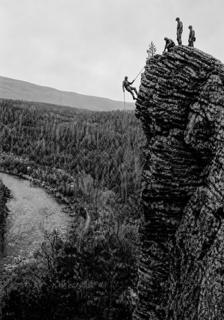
This episode has taken far longer than expected to produce, in no small part because it covers one of the least documented—and, I would argue, most consequential—chapters in the mountain troops’ history. When I started digging into the Army’s low-mountain warfare training program, I ran headfirst into a formidable challenge: almost nobody knew anything about it. What followed was one of the most demanding research projects I’ve yet undertaken for this show.
To understand the terrain, I drove the Blue Ridge Parkway in search of the crags where the mountain troops taught American GIs to climb and traveled to West Virginia’s Seneca Rocks to experience their training routes first hand. I made yet another research trip to the Denver Public Library and then spent months combing through archival reports, correspondences, photographs, maps, and personal papers to better understand the historical record. Piece by piece, those fragments revealed a story that has never been told in its entirety.
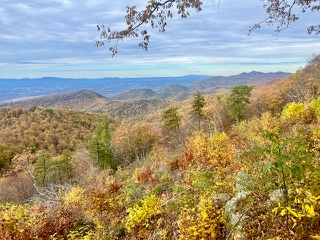
What you’re about to hear is the result.
Originally, I’d hoped to cover the program in both Virginias with a single episode. Instead, I’m eight months into the research and I’ve already got nearly two hours of material to share, so I’ve decided to split it up. Today, we’ll explore the origins and execution of the program in Virginia. In our next installment, we’ll follow the story, as well as our remarkable cast of climbers, soldiers, and instructors, to its conclusion in West Virginia and the remarkable collection of sandstone fins known as Seneca Rocks.
Today’s episode isn’t merely a forgotten footnote in the 10th’s story. The lessons learned in the Virginias influenced the Allied war effort in Europe, accelerated the development of military mountain training, and helped lay the foundation for postwar climbing in the United States. It’s one of those rare moments in our journey when we learn something completely new about the mountain troops—something important, fascinating, and heretofore unknown.
As always, I’m deeply grateful to our advisory board for their help and insights, as well as to our institutional partners—the 10th Mountain Division Foundation, the Denver Public Library, the 10th Mountain Division Descendants, and the 10th Mountain Alpine Club—whose support makes this work possible.
I’d also like to thank the members of our Patreon community.
Projects like this one don’t happen quickly. They require plane tickets, road trips, mind-numbingly dry research, interviews, and countless hours spent chasing leads that often go nowhere. Our patrons make that work possible. They’re the reason I can spend eight months unraveling a mystery like the one you’re about to hear.
In return, patrons receive extended interviews, bonus material, behind-the-scenes research notes, and exclusive content unavailable anywhere else. More importantly, they’re helping preserve and illuminate a remarkable chapter of American history that might otherwise remain buried alongside those who made it possible.
If you’d like to become part of that effort, visit christianbeckwith.com and click the bright orange Patreon button on the homepage. Every contribution helps keep this project moving forward, and every patron plays a direct role in bringing these stories to life.
I’d be remiss if I didn’t thank our sponsors as well.
Outdoor Research has been building innovative mountain apparel since 1981. I’ve been using their gear season in and season out for more than a decade. My Deviator hoody is the perfect insulation layer for my winter backcountry adventures, and my Ferrosi pants are a staple of my summer wardrobe.
The other day, a friend and I climbed a route above Delta Lake in Grand Teton National Park, and I added yet another OR piece to my quiver. The forecast called for eighty-four degrees and sun, but the mountains hadn’t read it. Between shifting clouds and oscillating temps, I found myself alternately venting and huddling in my Astroman Air Sun Hoody all day long. It shielded me from the sunshine, kept me warm amidst the cold, and wore like iron every time I reached deep into an abrasive crack for a jam. That sort of versatility is exactly what gets a piece added to my kit.
Outdoor Research’s tactical line is built around the same philosophy: practical, field-tested solutions designed to perform when conditions demand it and disappear the rest of the time. If you’re missing a mission-critical piece in your mountain wardrobe, check out their full lineup at OutdoorResearch.com.
It’s early June as I record this, and while the valley is abundantly green, everything above ten thousand feet remains locked in snow. Which means it’s go time for my CiloGear Worksack.
I’ve carried a lot of packs in the mountains over the years, and I’ve never owned a better one for alpine climbing. It’s lightweight, indestructible, rides like a dream, and swallows all the awkward, pointy parts of the job—crampons, ice axes, rope, rack—that poke you in the back with most other packs. I’m not sure how many days I’ve logged with it; it’s dirty as hell, but it still doesn’t have so much as a single hole in it. If you want the best alpine pack money can buy, have a look at CiloGear.com—that’s C-I-L-O-Gear.com–for your dream pack. And if you’re a military alpinist, check out CGStrategic.com, because they’ve got products for all your missions too built around the same cornerstones of functionality, durability, and necessity.
If you ski in the West, you know this past winter basically sucked. Storms were few and far between, temperatures were preternaturally warm, and the word of the season was, more often than not, “variable.” For someone who loves to ski powder, that’s one of the worst words in the dictionary.
In winters like these, it’s critical to be on skis that can make the most of the conditions no matter what they serve up. When it comes to powder, I turn to DPS’s Pagoda Tour lineup, which has that magical ability to make you feel like you can fly. And for the less than perfect turns lurking out there in winters where variable is the name of the game, their new Pisteworks line will keep you turning with confidence all season long.
Whether you’re chasing powder, carving groomers, exploring big mountain terrain, or touring deep into the backcountry, DPS skis are handcrafted in their state-of-the-art U.S. factory to keep you smiling through every turn.
Learn more at DPSSkis.com.
For more than thirty years, Snake River Brewing has been crafting award-winning beers in the shadow of the Tetons. Whether your tastes run toward the hoppy bite of a Paco’s IPA, the crisp finish of a Snake River Pale Ale, or the malt-forward character of a Jenny Lake Lager, their delicious brews off the perfect finish to any great mountain adventure.
You can find Snake River beers throughout the West, and if you’re passing through Jackson, stop by their brewpub for excellent food, great beer, and a healthy dose of local character. Visit SnakeRiverBrewing.com to see what they’ve got on tap.
And with that, let’s return to our story, where our hero, John McCown, is about to demonstrate the value of mountain training to one of its biggest skeptics.
2nd Lieutenant John McCown had two opinions of Lieutenant General Lesley McNair. Only one of them would have avoided a court martial.
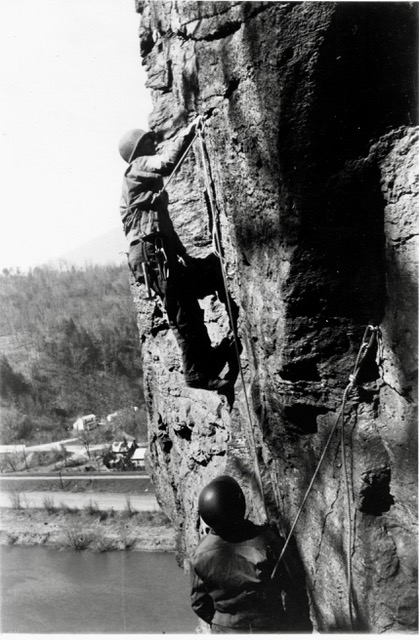
John stood a few yards back from the belay line, broad-shouldered and bow-legged, his thumbs hooked in his pistol belt as he watched soldiers from Arizona and Oklahoma and New Mexico execute maneuvers that two weeks ago they wouldn’t have been able to conceive of doing. Up and down the quartzite cliff, infantrymen were placing pitons in the horizontally fractured rock, tap tap tapping them home with their hammers while suspended high above the ground on manila ropes. A team from one of the 45th Division’s regimental intelligence platoons was rigging a suspension traverse across a hundred-foot gap with the focused economy of soldiers under scrutiny from the brass. Below them, other GIs were disassembling an 81mm mortar and rigging it to a three-to-one pulley system for hauling. When they’d arrived in Virginia they hadn’t known how to tie butterfly knots. Now, after ten days of concentrated training, they could use them to haul a piece of artillery up vertical terrain in the dark.
The brim of John’s army helmet shielded his eyes from the mid-day sun, but he could still feel sweat slicking his muscled neck as he watched the soldiers climb. The James River ran swift and cold and powerful beside them, carrying the last of the winter snowmelt south toward Lynchburg and the sea. To the east, the flanks of the Blue Ridge that had been so spindly and barren when they’d arrived shimmered in riotous explosions of green. Soon, he knew from his time at the University of Virginia, the trees would no longer be visible for the leaves.
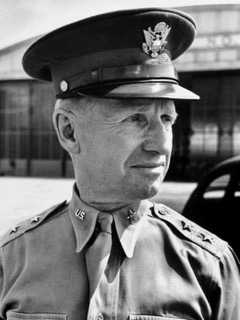
As nonchalantly as possible, he turned his head until he could see McNair with his hands clasped behind his back observing the proceedings. Brigadier General Onslow Rolfe stood at his side, surrounded by the retinue of officers he’d brought with him from Camp Hale. What did they think of this? John wondered. McNair had relieved friends, West Point classmates, and generals alike of their duties when they’d failed to meet his expectations. If this demonstration went awry, John had no doubt he’d dismiss Rolfe as well.
“What do you think, sir?” said a skinny nineteen-year-old at John’s elbow. It was Private Arte Argiewicz, grinning per usual behind his wire-rimmed glasses, a white ribbon around his helmet denoting his status as an instructor. “Should we invite General McNair to join us? Rope him up and help him off the cliff to see if these GIs can catch a fall?”
John kept his eyes on the soldiers. “Lower your voice, Private.” Then, in a register only the Californian could hear: “And get your mind right, Arte, for God’s sake. He doesn’t need help finding reasons to shut us down.”
It had been six weeks since John, Arte, and seventeen other instructors from the Mountain Training Center had followed Rolfe and company east to Virginia. They’d been loaded into the back of a cargo truck at Camp Hale in early March, driven down to the Colorado Springs Air Corps base, and flown in a twin-engine C47 transport plane to Washington, DC. From there, they’d been trucked another three hours to the Arnold Valley and a field of Army tents just outside the tiny town of Buena Vista. Though the only rock climbing they’d done as a unit had taken place the summer before on a thirty-foot log wall in the Ft. Lewis gravel pit, they’d been tapped by Rolfe to prepare men from the 36th and 45th Infantry Divisions to climb—training, if the rumors were true, for an Allied invasion of Sicily. They’d had no manuals to guide their instruction, no sense of how long the mission would last, and no definition of what success would look like. In other words, it was business as usual. Which was fine by them: they’d been making it up as they went along from day one anyway. No reason this assignment would be any different.
But today—April 10, 1943—this day was different. McNair’s visit was not your run-of-the-mill inspection. It was the Commanding General of Army Ground Forces coming to assess whether the mountain troops’ expertise had any value to the broader war effort. He was there to determine whether the considerable investment he’d made in these increasingly famous media darlings had resulted in transferable skills that could turn standard infantrymen into cliff-climbing killing machines.
Forty feet above the deck, a corporal was clutching an edge as if his life depended on it. His right leg had begun to shake up and down like a sewing machine.
“Watch me,” he said, in a drawl that carried above the river noise.
“Breathe,” Private James Goodwin called from the ground, his voice steady and unhurried. “There’s a piton at your waist. Look around you.”
The soldier hesitated, then swiveled his helmeted head and spotted an edge near his boot that he’d overlooked. He bumped his foot to it and repositioned. As he did, his leg stopped shaking.
“Better,” Goodwin said.
Haloed by the sky above, Sergeant Peter Gabriel’s helmeted head appeared over the lip of the cliff as he supervised the suspension traverse. He moved along the edge with the nonchalance of someone at ease with exposure.
“Ja, double check ze knots,” he said, in his heavy German accent. “Ve need ze speed, but ve need ze safety too.”
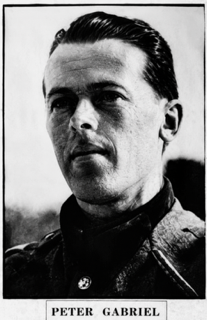
A young, stocky private from Albuquerque listened as Gabriel spoke, then turned to inspect his knots. When he’d arrived in camp two weeks ago he’d vowed never to climb higher than his own chin. Now he was one of the unit’s best, moving like a spider over stone.
“Think he knows what he’s looking at?” Arte whispered, sneaking a peak at the general.
“He knows what he’s looking for,” John answered.
Both of them knew all about McNair, for he was the architect of the Army in which they now served. In November, John had listened to McNair’s Armistice Day address over the radio in his Ft. Benning barracks. He’d read The Saturday Evening Post profile of the general that had come out in January until he’d dog-eared the pages. He knew that McNair was fifty-nine years old, banged out orders every night on a typewriter he’d named Elsie, accepted one dinner engagement per month and actively avoided publicity because he considered it a waste of time. He’d learned that McNair positioned himself in meetings to read lips because a lifetime around artillery had left him hard of hearing. McNair’s contempt for large bureaucracies was legendary. So was his disdain for “metallic generals” — officers with silver in their hair, gold in their teeth, and lead in their pants. He believed so strongly in the importance of tough, realistic training that he advocated for the use of live ammunition on the grounds that its dangers were preferable to the finality of combat. More than 120 soldiers had died during the 1941 General Headquarters maneuvers that he’d overseen — the largest peacetime military exercises in American history. As tragic as the losses had been, he considered them worth it, because they exposed deficiencies that would have killed more Americans in combat. He had flown 80,000 miles the previous year alone to observe unit maneuvers firsthand and had just expanded the Army from a couple hundred thousand Old Regulars to nearly seven million civilian soldiers in less than two years — a staggering, near-miraculous feat, built largely out of men like John and Arte who had never worn a uniform. The triangular division, the training programs, the maneuver system, the doctrine — all of it traced back to McNair in one way or another. He was manifestly competent, and his commitment to his soldiers was absolute—as was John’s respect for everything he stood for and everything he’d accomplished.
But McNair was also the source of all the doubt and equivocation and mixed signals that had wreaked havoc on the test force’s morale since the Fort Lewis days. He was the institutional skeptic of specialization in general and the mountain troops in particular, and he believed that a standard infantry division could, with a bit of fine tuning, be prepared to operate in rugged, mountainous terrain.
“Slack,” called a private. He was a compact second-generation Mexican-American named Alejandro who’d clerked in a grocery store outside of Albuquerque before the war. John had found his can-do attitude infectious, and he’d used him as a model for much of his instruction. Alejandro’s belayer — a nineteen-year-old ranch hand from Prescott, Arizona — let out an arm’s length of rope with practiced precision. Jose pulled it up and clipped it through a snaplink on a piton he’d driven himself, in a crack he’d chosen himself, on a line he’d selected after studying the rock for two minutes the way John had taught him. A few weeks ago he hadn’t heard of a piton. A few weeks from now he’d be sailing on a troopship, preparing to fix lines up a cliff face as soon as the landing boats hit sand.
As John watched McNair watching the soldiers climb, he felt two things simultaneously: a genuine respect for the General’s institutional position, and a bone-deep conviction that he was wrong about the mountain troops in a way that was going to cost privates like Alejandro their lives.
I first became aware of the 10th Mountain Division because of a photograph.
On page 181 of Chris Jones’ 1976 opus, Climbing in North America, there’s an image of a trapezoidal belay tower, roughly twenty feet high and overhanging on all sides, built by the Army Corps of Engineers in the summer of 1943 near Seneca Rocks, West Virginia. In the photo, a dozen soldiers stand atop the inverted turret, peering down at half a dozen troops awaiting their turn to climb.
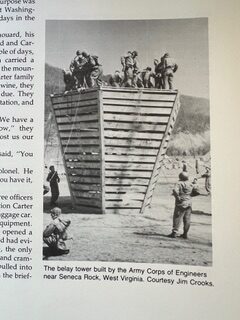
Jones’ book is a 392-page history of vertical endeavors on this continent. That single photograph, plus two and a half pages of accompanying text, constitutes the entirety of his coverage of the 10th Mountain Division and its relationship to American alpinism. It isn’t much: five paragraphs on the war’s impact on equipment development; eight paragraphs on the story of a briefcase; and a single paragraph on the 10th proper that focuses primarily on Riva Ridge.
The briefcase belonged to General Antoine Béthouart, an instructor at the French High Mountain Military School who’d been appointed head of the French military mission in Washington DC during the war. H. Adams Carter, the Harvard mountaineer turned godfather of American military mountaineering doctrine, had invited him for a few days of climbing on New Hampshire’s Mt. Washington, ostensibly to test mountain equipment. Wherever the French alpinist and his retinue went, the briefcase went with them. At the end of the trip they stopped at the Carter family home in Jefferson for dinner, polished it off with the requisite wine, then realized they were late for their train. In their haste to get to the station, the briefcase went missing. When Carter found it and returned it to them, “[t]he Frenchmen hugged him,” according to Jones, “as though he just won the Tour de France.” Carter would later learn that it held the French copy of the Normandy invasion plans. By returning it, he had ensured the invasion would proceed as planned.
But it was the photograph from Seneca Rocks, a parade of ancient hardened sandstone plates in West Virginia’s Allegheny Mountains treasured by generations of American trad climbers, that eventually sent me down yet another rabbit hole in our story. This one has been overlooked, until now, for good reason: Seneca Rocks, and the maneuvers in Buena Vista that preceded them, were two of fourteen special missions that exported mountain troop expertise to the broader Army. Only a fool would try to include them all in a single narrative.
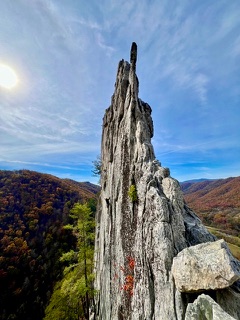
Fortunately for you, dear listener, I’m that fool, and this is part one of that narrative.
We’ve explored half a dozen of these special missions in previous episodes already. They included the April 1942 ski trip to Sun Valley that, under the direction of Hollywood’s Metro-Goldwyn-Mayer, produced winter training films for the mountain troops; the expedition to the summit of Mt. Rainier in winter conditions followed closely thereafter by the one to Denali that tested equipment while netting the third ascent of North America’s highest peak in the process; and the Columbia Icefields expedition that perfected the Weasel, a lightweight, oversnow vehicle that British Prime Minister Winston Churchill planned to drop into Norway to wrest control of a heavy water plant from the Nazis before they could use it to build an atomic bomb.
As our advisory board member Sepp Scanlin points out, these missions were more than quixotic tangents in the mountain troops’ evolution.
Sepp Scanlin: “They are teaching all these troops from the leadership that is running these large-scale geographically dispersed operations to the mid-grade officers to the NCOs and soldiers to begin to operate in these very unforgiving environments with very nebulous instructions and to build their leadership skills.“
The maneuvers in the Virginias are two more examples of these missions and they too would have carry-on effects that would have been impossible to anticipate in advance. They’re also, arguably, the most significant ones we’ve covered to date, because they’re the moment the mountain troops’ expertise stopped being theoretical and became, for the first time, a matter of life and death for American soldiers headed to battle.
Historians wiser than I am have largely ignored them. In his book, Ski Climb Fight, our advisory board member Lance Blyth devotes three paragraphs to the Virginia maneuvers and another three to Seneca Rocks. In The Winter Army, Maurice Isserman gives Seneca Rocks a single paragraph and none at all to Buena Vista. McKay Jenkins, author of The Last Ridge, mentions neither. Even Hal Burton — who, as we’ll discover, was actually one of the instructors at Seneca Rocks — devotes only a few lines to them in his history of the unit, The Ski Troops.
There’s a reason for this neglect, and it traces directly to the outsize role skiing has played in the 10th’s public image. Because the National Ski Patrol recruited and vetted the Division’s volunteers, and because America had fallen in love with skiing before the war, the 10th has always been seen through a skier’s lens. The climbing — and in particular, the transfer of climbing expertise to the broader Army and from there to the American public — has remained an asterisk to a saga that sprawls enough without yet another sidebar.
That changes with this episode.
My thesis, having studied both the Virginia and West Virginia maneuvers closely, is this: they — and not anything that happened high in the mountains of Colorado — marked the first time significant numbers of soldiers in the United States Army learned to operate in mountainous terrain. In teaching them to do so, the Mountain Training Center proved that standard infantry could be prepared for the sort of rugged terrain they were about to encounter in combat.
Months later, the results would be tested in blood in Sicily and on the Italian mainland—and prove that they worked.
The Virginia maneuvers did something else as well. Before they began, the mountain troops had yet to figure out how to teach their own men to climb. When the MTC instructors returned to Camp Hale in mid-April 1943, they carried with them a proven curriculum that would inform their training that spring — and in the process lay the foundation for their assault, two years later, on Hitler’s Gothic Line.
And there was another carry on effect. By introducing the American GI to independent action in the mountains for the first time in the Virginias, they lit the fuse on the postwar explosion that Blyth has called one of the most significant developments in American outdoor recreation history.
That, then, is what this episode is about: what the mountain troops gave the Army, what the Army gave back to the mountain troops, and what both of them gave the country.
To understand why General McNair was standing at the base of that cliff beside the James River in the spring of 1943, we need to go back twenty-five years — all the way to a trench in France, where he was watching American soldiers die.
In 1917, the US Army sent The American Expeditionary Forces to France to fight in the Great War. Commanded by General John “Black Jack” Pershing, the AEF comprised, at its peak, more than two million US troops on the Western Front. It was the first time we had sent a large army off to war.
Pershing’s doctrine, which he called open warfare, held that the AEF would punch through the German trench system and then exploit the breakthrough with fast and lethal operations in the unfortified land beyond. His vision of infantrymen advancing with rifle and bayonet, supported by mobile artillery, pursuing a broken enemy across open ground proved wrong. When American forces achieved penetrations, they consistently failed to exploit them. Communications collapsed, artillery couldn’t keep pace with infantry, and officers who’d been trained for set-piece attacks proved incapable of leading fluid pursuit operations. As a result, breakthroughs that should have ended the war months earlier became costly stalls. Of the roughly eight million soldiers who died in battle on the Western Front, 63 per cent of them were Allied troops. In terms of numbers, that came out to some one and a half million more men than the Germans lost.
Lesley McNair witnessed the debacle from the inside. He’d spent thirteen years mastering field artillery before arriving in France as a thirty-four-year-old major. The AEF was desperately short of competent officers, and Pershing noticed him almost immediately. He pulled him to General Headquarters and put him in charge of artillery training for the entire AEF—which left McNair watching the American failures with the authority to fix them and the frustration of seeing them occur anyway.
By war’s end McNair had been promoted to brigadier general — the youngest in AEF history — and had formed a very specific set of convictions about what had gone wrong. The problem, he concluded, was not courage or numbers or equipment. The problem was that the infantry and artillery hadn’t trained together long enough, well enough or realistically enough to coordinate in the field. Everything he did for the next twenty-five years was aimed at preventing that failure from recurring.
During his Atlantic crossing to France, McNair had shared a stateroom with a fellow officer named George Marshall. Twenty-three years later, in 1940, Marshall — by then Army Chief of Staff — selected McNair to lead Army mobilization and training, and handed him an almost impossible job: expand the force by 4,000 percent in less than three years, and make sure they could survive encounters with an enemy that had been preparing for this war since the last one.
Part of McNair’s solution was the triangular division — three regiments, each containing three battalions, built for speed and flexibility rather than the massive, cumbersome square divisions of the First World War that had been too slow to exploit the breakthroughs. He also insisted on training so rigorous it bordered on the lethal. Perhaps his most important conviction, though, was a preference for versatile standard divisions that could be modified for specific situations. Specialized units required disproportionate amounts of resources the country simply didn’t have. With no clear understanding of where all the new divisions would be needed, McNair directed that they be trained for general operations, with situational training applied just before deployment on an as-needed basis. In his mind, it was the only way American forces could ramp up quickly enough, and effectively enough, to take on Hitler and the Axis powers.
Here are our advisory board members Sepp Scanlin and Lance Blyth.
Sepp Scanlin: “He is looking at training potentially up to 100 divisions. So he can’t do that in the timeline allotted if he does a division for this and a division for that and a division for this. He’s like, ‘You told me you need a 100 and you can’t tell me where you’re going to use each one of those hundred. So you can’t tell me how many mountain divisions you need, how many jungle divisions, how many amphibious divisions.’ He’s like, ‘Why don’t we make a bunch of common divisions and then just figure out how to fine-tune them with these specialty skills?'”
Lance Blyth: “McNair’s position was always, ‘Show me the requirement. Where are we going to have to fight in mountains? Show me what mountains we’re going to fight in, and then I can prepare for them.'”
In the spring of 1943, McNair needed to know whether his thesis was right, because he was about to send his forces into Europe for the first time.
The Blue Ridge Mountains of Virginia became the place to find out.
Though McNair had no way of knowing it, the tides of war had already begun to turn. The June 1941 German invasion of the Soviet Union known as Operation Barbarossa had not only shoved Russia into the Allied camp; eighteen months later, it continued to tie up the overwhelming majority of Hitler’s resources on the Eastern Front. Stalin had repeatedly pressured Britain and the US to open a second front in Western Europe that would force the Germans to divert troops away from Russia. The US, though, was still learning how to fight a modern war, Allied amphibious doctrine was immature, landing craft were scarce, and the Allies lacked the manpower, logistics, air superiority, and operational experience necessary to successfully invade northern France. A direct cross-Channel invasion was therefore viewed by many Allied planners — especially the British — as dangerously premature.
So they compromised. In November 1942, they launched Operation Torch: amphibious landings in Morocco and Algeria designed to introduce American forces to combat, clear Axis troops from North Africa, and open a second front while delaying a cross-Channel invasion until the Allies were ready.
In Episode 3, we detailed how German Field Marshal Erwin Rommel had honed his mountain fighting expertise in the Julian Alps during the First World War. He had spent the intervening years mastering mobile armored warfare as well. In early 1943, as American forces pushed east into Tunisia, they encountered seasoned troops under Rommel’s command—and McNair’s worst nightmare was realized.
Kasserine Pass is a gap in the Grand Dorsal mountain range in west-central Tunisia, about seventy miles southwest of the city of Kasserine. On February 19, 1943, Rommel launched an offensive that punched through thinly held American positions and drove west through the pass, advancing nearly fifty miles in two days. Caught flat-footed, some 6,500 US soldiers were killed, wounded, or captured. It was the first major defeat suffered by U.S. forces at German hands, and it exposed in catastrophic terms insufficiently trained troops, poor coordination between infantry and artillery, road-bound thinking, and inadequate small-unit leadership.
If there was a bright spot in the Allied efforts, it came from the East. Operation Barbarossa had reached Stalingrad in southwestern Russia the previous summer. Expecting a quick victory, Hitler had chosen not to prepare his army for cold weather operations. As the siege ground on, winter settled in. Temperatures dropped to minus ten, then minus twenty. By early 1943 they reached minus forty degrees Celsius. The Germans had no winter clothing, no cold-weather lubricants for weapons and vehicles, and inadequate rations. Rifles and machine guns froze. Vehicles wouldn’t start. Men died of exposure in their foxholes. Frostbite casualties ran into the tens of thousands.
Better prepared for cold-weather fighting, the Soviets used winter as a weapon. They attacked at night when German sentries were least effective, moved across terrain the Germans assumed was impassable, and maintained an operational tempo that their frozen, starving enemy could not match. On February 2, 1943, two weeks before American troops suffered their setbacks at Kasserine Pass, the German 6th Army surrendered at Stalingrad. Total Axis losses across the entire campaign reached nearly a million. Soviet losses were equally high, but Stalin’s willingness to absorb them was absolute. It was the largest single battle of the Second World War. For Hitler, it would also prove to be the beginning of the end.
The Russians called the cold General Winter. John McCown had watched it wreak its havoc on German forces while attending Officer Candidate School at Fort Benning. It was one of the determinants of his frustration with McNair and AGF: no ten-day finishing school could prepare standard infantrymen for those kinds of conditions.
By the time the Germans surrendered at Stalingrad, Allied planners were finalizing preparations for the next phase of fighting in the West: the invasion of Sicily, an inverted triangle of an island separated from Tunisia by ninety miles of open water and the toe of the Italian boot by a two-mile stretch known as the Strait of Messina. Axis air and naval forces based on Sicily threatened Allied shipping throughout the Mediterranean. Capturing it would reduce losses at sea, shorten supply routes between the Atlantic and the Middle East and improve Allied logistical efficiency. It would also create a springboard for the invasion of mainland Italy—which Churchill dubbed the “soft underbelly of Europe” — because it offered a less costly and more practical route into Axis-controlled Europe than a direct assault across the English Channel into France.
The assault was code-named Operation Husky. Because North Africa provided the ports, airfields, logistics network, combat experience, and forward staging ground that would make it possible, it depended on Operation Torch for success. It also depended on the development of specialized skills amongst its soldiers—skills John McCown and his fellow instructors were about to impart in Virginia.
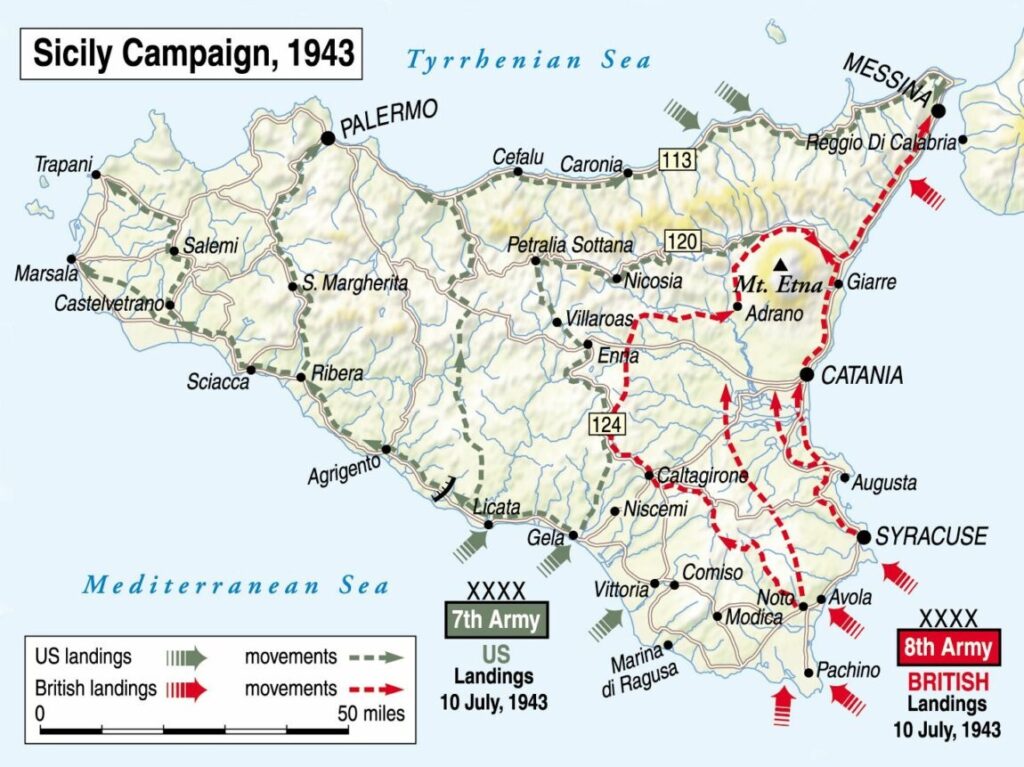
Sicily’s geography mattered enormously. Punctuated in the northeast by Etna, an active volcano rising more than eleven thousand feet above the sea, its interior is a corrugated landscape of hills, ridges and compartmentalized river valleys that favored the Axis defenders. Control of passes, observation points and bridges would be decisive, because movement would be frequently channeled by the terrain itself. The island’s road network consisted of a coastal ring road and not much else — meaning that any force advancing inland would need to be able to move, fight, and haul weapons across rough, broken, roadless terrain.
Among the American units scheduled to make their combat debut on Sicily’s beaches were the 36th and the 45th Infantry Divisions. The 36th, a Texas National Guard unit with deep roots in Lone Star tradition, had, as its shoulder patch, the letter T superimposed on an arrowhead, reflecting the state’s history as an independent republic. The 45th was one of the most ethnically diverse divisions in the American Army. Federalized in the fall of 1940, it included large numbers of Native American soldiers — particularly from Oklahoma’s many tribal nations — as well as significant Hispanic populations from New Mexico and Arizona. Its original shoulder patch was a swastika, an ancient Native American symbol that was quickly replaced with the Thunderbird after Hitler made the swastika political Kryptonite.
The 36th was scheduled to ship out April 1st, the 45th a few weeks later. Though both had received standard infantry training as well as preparation for large-scale maneuvers and amphibious invasions, the Sicilian landscape would require skillsets they’d yet to perfect.
Nathan Marzoli is a Senior Military Historian who currently serves as the Deputy Director of Historical Programs for the U.S. Space Force’s operational command. In 2019, Army History magazine published his 19-page article, The Best Substitute: U.S. Army Low-Mountain Training in the Blue Ridge and Allegheny Mountains, 1943–1944”. It is the only comprehensive overview of the training program known to exist. Here’s how he describes it:
Nathan Marzoli: “The army was preparing to invade Sicily. And that island, and then of course once you get on to mainland Italy as well, is very mountainous, but it’s not exactly the high mountains like you have in Colorado or anything in like the Alps. They’re considered what the army called low mountains which are basically mountains probably around 2,000 to 4,000 feet high above sea level that don’t have snow and ice year-round like the higher peaks, a rough road net and tons of streams that sort of cut up the terrain. So it’s very rugged terrain [but] not as extreme as the higher mountains. They needed to prove that these standard infantry divisions that were planning to invade Sicily—that they could actually operate in this type of terrain. So what they did is they set up this what they called a low mountain training area in the west central Virginia mountains. Established it basically for the 36th and 45th infantry divisions which were scheduled to invade Sicily in the spring of 1943.“
And here’s how our advisory board member Lance Blyth describes them.
Lance Blyth: “What they wanted to do was give these divisions or actually parts of these divisions the opportunity to train for places like Sicily that had very rough terrain and very bad roads. So it would be hard to move through and it would be hard to bring supplies forward because there weren’t a lot of roads to do that with.“
While the 45th would be starting its low-mountain training from scratch, the 36th was another matter. Six months earlier, 200 of its officers and noncoms had received instruction in climbing—making it the only unit in the Army outside the mountain troops themselves to have done so. Said instruction had, predictably, come via the mountain troops, in the form of yet another special mission, with a backstory worthy of Hollywood.
Nearly a year after the 87th Mountain Regiment had been activated at Ft. Lewis, a directive arrived from Army Ground Forces. Private John Reid was a New England skier who had joined the unit in June. In an email to our advisory board member Jeff Leich, he recalled that, in September, shortly after he’d completed basic training, “from out of nowhere came an order for a number of us to put all of our equipment and belongings in our barracks bag and stand out by the road in ten minutes. We knew nothing about when or where we were going, or why we were selected.” Along with ten officers and fifteen other enlisted men, Reid was trucked to a train station. The men soon found themselves headed east, destination unknown.
Days later they arrived at Boston South Station. From there, they were trucked to Camp Edwards on Cape Cod, where they were briefed by a high-ranking general “who told us that our mission was top secret, not to be divulged to anyone.” The next morning they were loaded back into transport trucks and started off once more.
Reid figured they were destined for Europe. Instead, they pulled up in front of the Lincoln Hotel in the village of Lincoln, New Hampshire. “A general grouped us together,” Reid remembered, “and gave us a lecture on secrecy — or else.” Though a number of them had grown up in New England, they were forbidden from contacting their families, even if they lived close by. Their mail, they were told, would not only be strictly censored; it would be mailed from a different location.
After being broken into groups, they were given a table of organization, informed they would be teaching climbing and mountain survival, and assigned Texans from the 36th to instruct. “We were also told again,” Reid remembered, “that our mission was top secret, not to be told to anyone outside of army personnel.”
Each day they were trucked two miles to Franconia Notch, where, on the granite slabs of Cannon below the Old Man of the Mountain, they taught the Texans to climb. “Needless to say,” Reid wrote, “the men from the 36th … were a little more than worried about learning to climb the steep mountain faces.” Soon, though, they had the skills they needed, as Reid put it, “to give them confidence and courage in these unusual circumstances”—how to navigate shifting boulder fields and tottering talus, rope up when the terrain kicked back, climb in parties of two and three, and then rappel back down again.
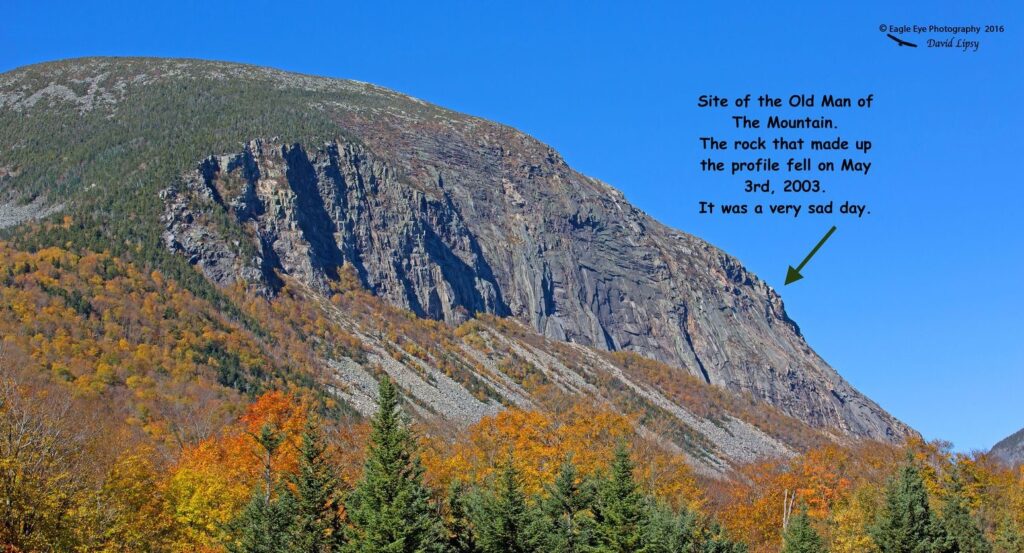
It was the height of autumn, and the mountains were ablaze with color, but as delightful as climbing amidst such conditions might have been, the evenings proved even better.
“We were fed the best food you could ever imagine at the Lincoln Hotel, served on white linen tablecloths in their fine dining rooms,” Reid remembered. “The food was memorably great — good meat, fresh vegetables, mashed potatoes with gravy, delicious pies and cakes, not at all like army food…. It was all too good to be true.”
At night, though, the reasons behind the secrecy began to reveal themselves. Reid and his companions were put to work studying Norwegian with a Harvard instructor in the local schoolhouse. “We studied hard and learned many words — even how to make out with a girl,” Reid wrote. The lessons seemed to suggest a greater purpose. “We thought that our group might be headed for the fjords of Norway to set the ropes for an invasion.”
Over the course of two weeks, under the cloaks of secrecy, the mountain troops taught one hundred officers and NCOs of the 36th the fundamentals of climbing, then taught 100 more over a second fortnight. Those two hundred Texans in turn proceeded to teach others in the 36th what they’d learned, using wooden climbing walls modeled on the ones the 87th had erected in the Fort Lewis gravel pit. When the weather turned, classes moved inside, and Reid and his fellow instructors lectured the Texans on the finer points of winter warfare. Finally, on November 15, Reid and company were shipped off to Camp McCoy, Wisconsin, where they were ordered to train elements of another division to fight in the cold.
The Lincoln Detachment’s primary purpose was not, as it turned out, to teach the 36th to climb. As the Army’s own postwar history later confirmed, it was strategic deception — part of an elaborate intelligence operation designed to persuade the Germans that an Allied invasion of Norway was imminent. The ruse, which was predicated on the assumption that local spies would report the training, and the Norwegian lessons, to their Nazi handlers, succeeded. Four days after the men of the 87th wrapped up their assignment, Allied forces landed in Morocco and Algeria—just as Hitler was moving German troops north to counter a Norwegian invasion that never came.
Like the Texans of the 36th, the men of the 45th Infantry Division had received specialized training, but they’d yet to learn to climb. Operation Husky would require vertical skills on top of everything else. Only one commanding officer in the United States Army had any expertise in mountain warfare: General Onslow Rolfe, aka Pinky, the red-headed infantryman with a mountaineering problem—and so he got the job.
If you’ve been listening to this podcast, you know that Rolfe’s presence in Virginia requires an explanation. At the conclusion of our last episode, we detailed how he was relieved of his duties at Camp Hale as Commanding General of the Mountain Training Center in July 1943, as the test force he’d been nurturing since birth was being converted to the 10th Light Division (Alpine). The chain of events leading to his replacement were complex, but they were abetted in no small part by the Homestake Peak Maneuvers — the exercise that pulled a thousand inadequately prepared mountain-troops-in-training into the Colorado Rockies in February 1943 with disastrous results.
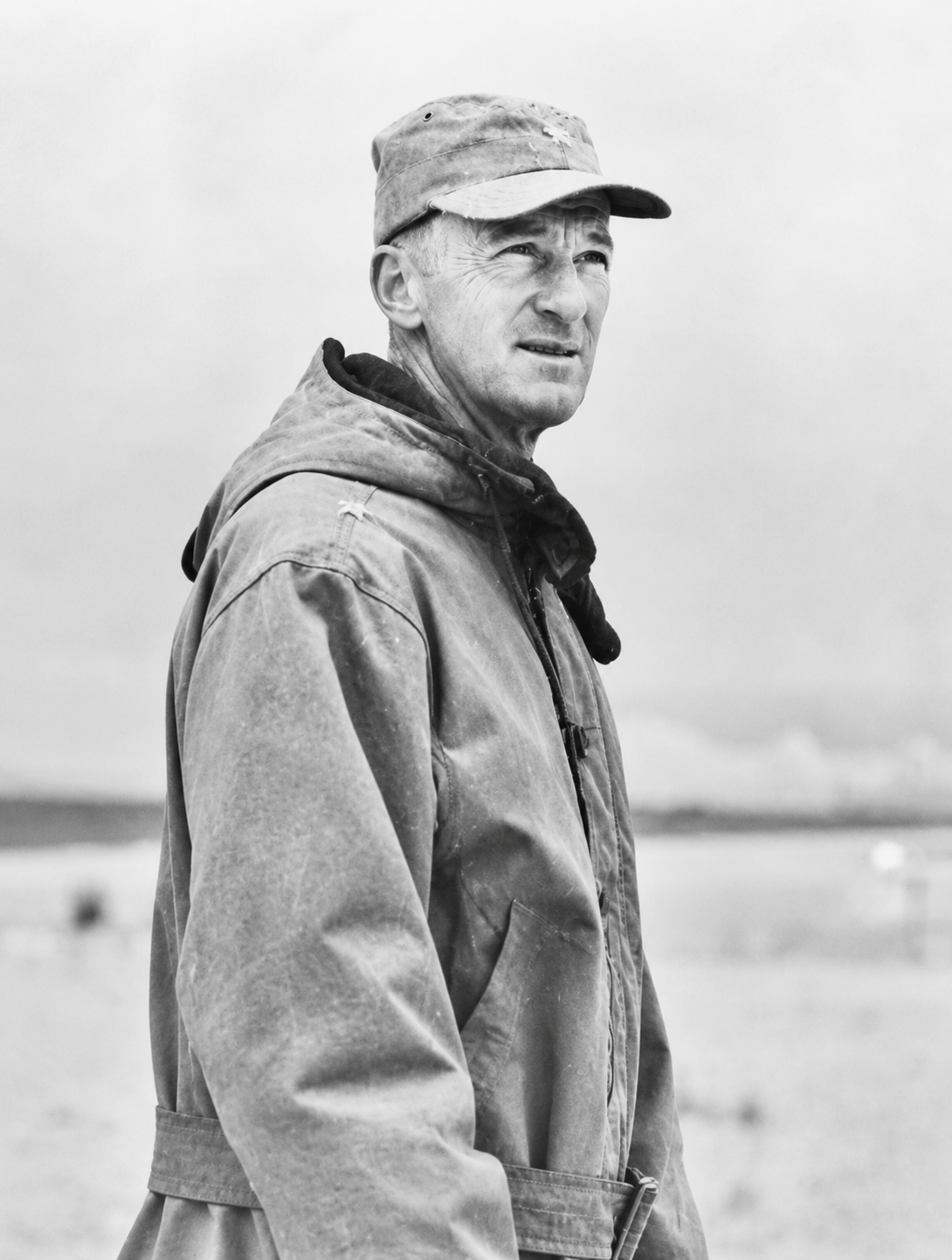
Given Rolfe’s role in the Homestake Peak Maneuvers, I certainly didn’t expect to see him less than a week later in Virginia. Neither did any of our Advisory Board members. But there he is, in an Army Ground Forces order dated February 18, being directed to AGF headquarters in DC, where he was to report upon arrival to the Commanding General of Army Ground Forces — the five-foot-six, audibly challenged officer known universally as Whitey for the color of his hair, Lesley McNair.
At this point in the war, McNair had one overriding concern, and he’d carried it with him since his experiences in France: that American soldiers train hard enough and realistically enough to survive contact with the enemy. I mentioned the Armistice Day address he’d given to his troops in November. In it, he’d noted that the day that memorialized the end of the Great War was not a celebration. It was a reminder that America had once gone to war unprepared. We could not, he said, afford to do so again.
As McNair spoke of enemies who had been preparing for this war since the last one — military societies whose soldiers fought relentlessly, furiously, unscrupulously, with every means available and no fear of death—General Rolfe and John McCown would have been listening. The only way the American soldier could hope to defeat enemies such as these, McNair told them, was to match their ferocity with our own.
“Our soldiers,” he said, “must have the fighting spirit. If you call that hating our enemies, then we must hate with every fiber of our being. We must lust for battle; our object in life must be to kill; we must scheme and plan night and day to kill. There need be no pangs of conscience, for our enemies have lighted the way to faster, surer, and crueler killing; they are past masters. We must hurry to catch up with them if we are to survive. Since killing is the object of our efforts, the sooner we get in the killing mood, the better and more skillful we shall be when the real test comes. The struggle is for survival—kill or be killed.”
The speech was broadcast over the Blue Network. Rolfe would have heard it at Camp Hale. John McCown would have listened at Ft. Benning, perhaps alongside his fellow mountain troopers and OCS candidates Charlie McLane and Worth McClure. One can imagine them stiffening when McNair addressed the Army’s officer class. They were, he’d said, “the broad foundation on which our war army is being built.”
By the time Rolfe arrived in DC, that war army was giving McNair plenty of reasons for concern. The defeat at Kasserine Pass was unfolding in real time — American units caught flat-footed once again, routed by an enemy that understood terrain and movement better than they did. The German 6th Army’s destruction on the frozen Russian steppe was another testament to the same thing. The lessons in both cases were ones McNair had spent twenty-five years trying to teach: preparation is mandatory; the enemy will find your weaknesses; and soldiers who have not been hardened by realistic training will either get lucky in combat or die.
As Sepp Scanlin points out, the sprawling, interconnected conflict McNair was attempting to navigate required the strategic equivalent of 4D chess.
Sepp Scanlin: “Everything is starting to fall in place with the production in the United States of both the material for the war, but also the manpower for the war. So, there’s more divisions coming online, and they are preparing to deploy them overseas to begin to expand their war efforts on the southern front.
“Simultaneously, they’re also beginning to look at how they’re going to move forces into the UK to prepare for the cross channel. And there’s all sorts of big debates that are going on in this period because a year from now they’re going to do the Normandy invasion. So they’re already having to begin thinking through where all the forces are going to flow over time to get them where they need to be for how they envision the war executing. So they’re balancing out the Mediterranean theater as we would call it and then the opening of the main European theater.
“But all of those things are starting to nestle because the forces that they need to do that are coming out of their training pipelines, whether that be the infantry, the armor and all the support forces as well as the ability to move those forces to those locations. So the logistical pipeline of loading all those troops and moving them to those different locations is also like a pipe limiter because they’re still doing convoy operations due to the U-boat threat and things like that. So it’s this complex puzzle that people like McNair are trying to make sure continues to move forward in conjunction with the larger strategic vision that is also shifting.”
Suffice it to say that when Rolfe came to town, McNair had a lot on his mind.
In addition to John McCown and his fellow instructors, Rolfe’s retinue included eight other officers from the MTC. On February 22, Army Ground Forces laid out their mandate in a series of directives: Rolfe and company would be responsible for what the Army called low-mountain training, and it was to be conducted in Virginia’s Blue Ridge Mountains, amidst terrain that offered the best approximation of Sicily the Army could find on short notice.
John McCown would have been able to see the Blue Ridge from the University of Virginia campus in Charlottesville, where he’d spent twelve weeks studying law before Pearl Harbor prompted him to drop out and join the 87th at Ft. Lewis. Rarely wider than twenty miles across, the Blue Ridge is not a dramatic mountain range by western standards — no glaciers, no talus fields, no summits higher than four thousand feet — but it slashes through the western part of Virginia like a scimitar, a long, skinny spine of densely forested, rugged hills vexed by heavy undergrowth and interrupted by hollows, deep ravines, numerous large streams and, importantly, few roads.
Sixty miles southeast of the UVA campus, on the western flanks of the range, lies the working town of Buena Vista. In 1943 it boasted a population of 6,700 residents, a tannery, a pulp mill, and a depot along the Chesapeake and Ohio Railway. The unincorporated community of Lowesville, a logging hamlet of a couple hundred folks, is located on the eastern side of the range. Between them lies twenty miles of hill country, all of it protected from development by the Pedlar and Glenwood Districts of the George Washington and Jefferson National Forest.
It was easier, during the war, for AGF to lease public lands for maneuvers than it was to negotiate with private land owners, so there was that; but the location had something else going for it as well. Ninety minutes away lay Camp Pickett, a training installation near Blackstone, Virginia, where the 36th and 45th were already staging.
Rolfe’s orders for both divisions were the same: prepare them to fight in the mountains. The official language put it this way: he was to “familiarize the units with operations in mountainous and primitive terrain,” characterized by “independent action of small infantry units supported by artillery to seize key terrain features in order to open lines of advance for wheeled vehicles.” In layman’s terms, that meant whipping the troops into shape and familiarizing them with something the mountaineer knows well: independent, autonomous action. It was the military equivalent of going alpine style.
To operate in the mountains, you need to be fit. Carrying a heavy pack for hours on end over steep, uneven ground that conspires to trip you up at every step is exhausting work, and when you factor in the navigational skills necessary to find the most efficient line through a broken, trailless landscape, the physical complexities take on psychological dimensions. Now add limited visibility, stream crossings, variable weather, the need to keep the people around you hydrated, fed, focused and moving in concert, communication with your superiors, disruption by the enemy, and the need to kill said enemy before he kills you, and you begin to understand what Rolfe was being asking to accomplish.
Rolfe’s directives went further. AGF’s training program required him to coordinate artillery support of infantry, the securing of battery positions, the maintenance of communication and supply lines, and the improvement and extension of roads and trails across terrain standard divisions had not been trained to navigate. Needless to say, there was no playbook for any of this in the AGF library. And from the time he touched down in DC to the time the maneuvers began, he had less than two weeks to set it all up.
Business as usual.
Three days before the maneuvers were scheduled to begin, a man with more than a passing interest in their development arrived to check on preparations. In fact, he’d been advocating for specialization longer than nearly anyone in the Army.
Colonel Ridgely Gaither was a career officer who’d risen through the ranks until landing behind a desk at AGF headquarters in 1940. There, he’d been tasked with exploring “the matter of special troops,” as Hal Burton put it, in The Ski Troops, “that might be used in out-of-the-way areas — exotic places, such as mountains and jungles, on seashores where amphibious troops might land, and in the sky above the battlefields.” While the dossiers on all these specialties were limited, the file on mountain warfare in particular was, Burton noted, “mighty thin” — a couple of European handbooks on the topic, a few reports on the Finnish Winter war, and not much else.
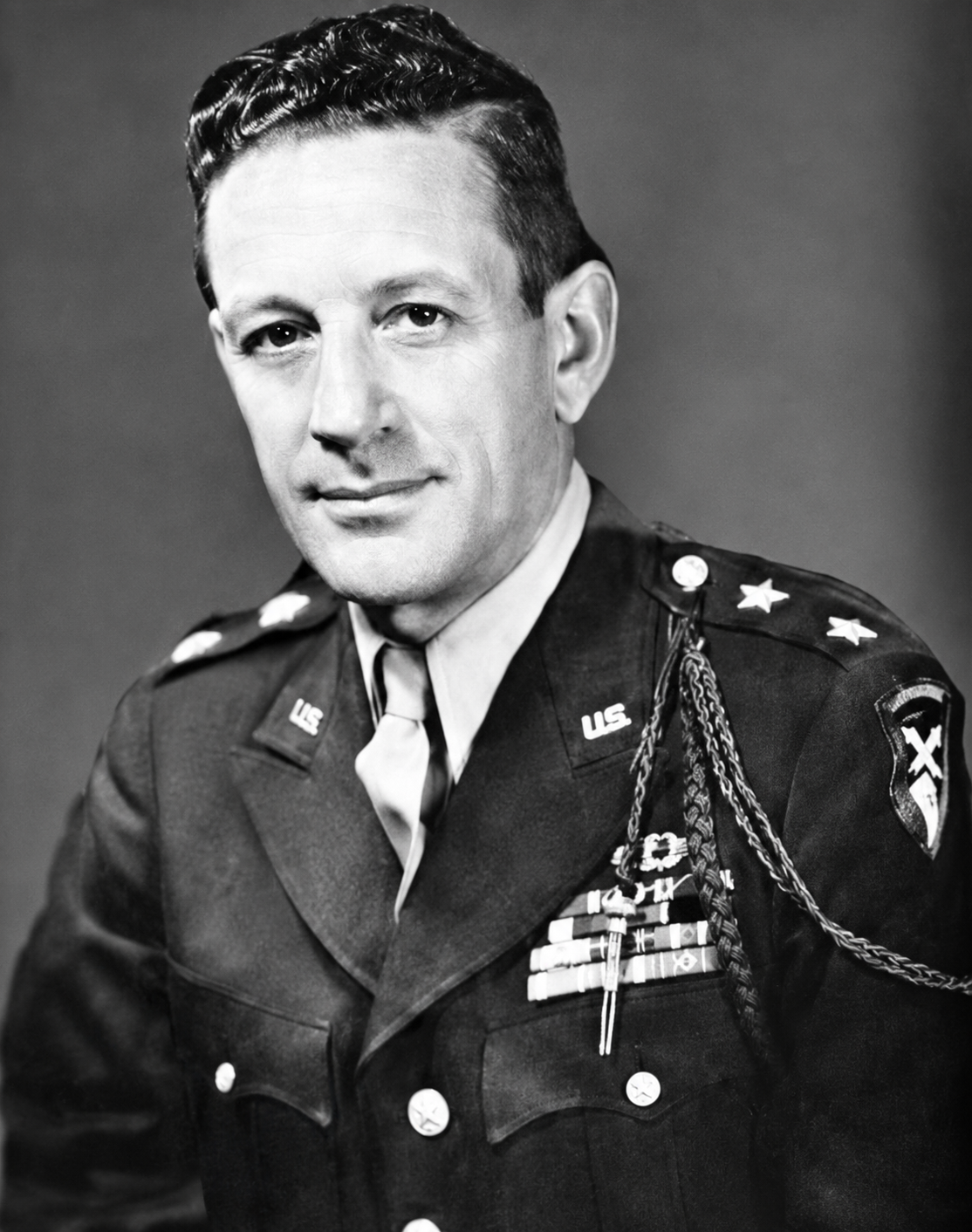
Thanks to a combination of intelligence, tenacity and political persuasion, Gaither eventually received the go-ahead for a dozen specialized divisions of jungle, airborne, and amphibious troops. He also got the green light for not one but three full mountain divisions, the 10th, 12th and 14th—a remarkable achievement, given the country’s negligible mountaineering culture, the Army’s almost complete lack of cold-weather and mountain fighting expertise, and the war department’s resistance to specialization in general. Though AGF’s ambitions eventually contracted to just the 10th, the fact that it existed at all was due, in large part, to his efforts.
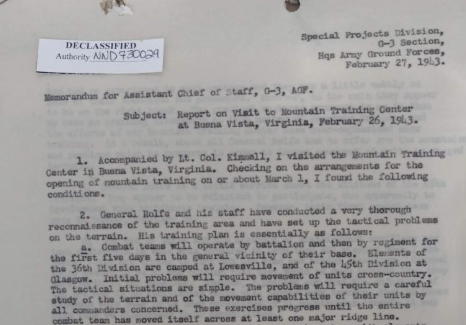
Gaither arrived in Buena Vista as the Chief of the AGF’s Special Training Division. His report, which he typed up on February 27, 1943, the day after his visit, noted that the program’s greatest weakness was the same thing that had haunted specialized mountain training since its inception. “We have no training literature on this matter of mountain training,” he wrote.
“The efforts of our Mountain Training Center have over-emphasized snow training,” he continued. “As a result, about all General Rolfe has to offer are the mountains and problems which he prepares in order to insure movement of units in rugged terrain.”
To which the informed observer might respond: obviously. Apart from a few limited forays on Mt. Rainer the summer before, the only warm weather training they’d been able to do had taken place in a gravel pit. In the autumn, the entire shooting match had been shipped out to a brand-new encampment at 9,200 feet in the Colorado Rockies just as the snows had begun to fly. Of course they’d over-emphasized snow training; it was the only training they’d actually had time to practice.
Overall, though, Gaither gave Rolfe and his staff two thumbs up. They had, he wrote, “conducted a very thorough reconnaissance of the training area and … set up the tactical problems on the terrain.”
They’d also come up with a plan.
Under the Mountain Training Center’s supervision, AGF had established its headquarters in Buena Vista. The maneuvers themselves would take place out of two nearby camps. Fifteen miles east of Buena Vista, on the other side of the Blue Ridge, they’d set up North Camp near the logging community of Lowesville. Eight miles south of Buena Vista, on the western side of the mountains, they’d put together a second, smaller camp, known as South Camp, in the Arnold Valley along the James River.
Each camp would host Combat Teams from the 36th and 45th in rotating, two-week increments. North camp would get Regimental Combat Teams minus one battalion, while South camp would host Battalion Combat Teams.
If you’re a civilian like me, you probably have no idea what either Regimental or Battalion Combat Teams are, so here you go (and if you really don’t care, feel free to fast forward for the next minute or so).
A Regimental Combat Team, or RCT, is a combined arms task force built around an infantry regiment’s three battalions, with artillery, engineer, medical, and other supporting elements attached to make it a self-sufficient tactical unit capable of independent operations. It was the standard building block for the kind of training AGF was conducting at Buena Vista — large enough, at 4,000–4,500 men, to conduct meaningful exercises, and small enough to rotate through a maneuver area in a manageable timeframe.
A battalion combat team, meanwhile, was a self-contained combined-arms force built around an infantry battalion and reinforced with artillery, engineers, communications personnel, medical detachments, and other supporting units. Typically numbering around a thousand men, it was designed to operate independently for extended periods, making it well suited to the dispersed and decentralized nature of mountain warfare.
Once you subtracted a battalion, North Camp’s RCTs came out to somewhere around 3,500 men, while the battalion combat teams at South Camp would number roughly 900.
John McCown and his fellow instructors were posted at South Camp, where they were to teach the esoteric art of assault climbing to small groups of soldiers drawn from the Battalion Combat Teams training in the Arnold Valley—between sixty to one hundred men at a time. Those soldiers would then return to their units and serve as instructors themselves, spreading the techniques throughout the division much as the Texans of the 36th Infantry Division had done before them.
And what, you might ask, is assault climbing?
“Assault climbing,” explained the Foreward in the Handbook for Assault Climbing, which was published later that year, “enables the infantryman, the artillery observer, or the trooper of a reconnaissance unit to fulfill his mission in mountainous terrain.”
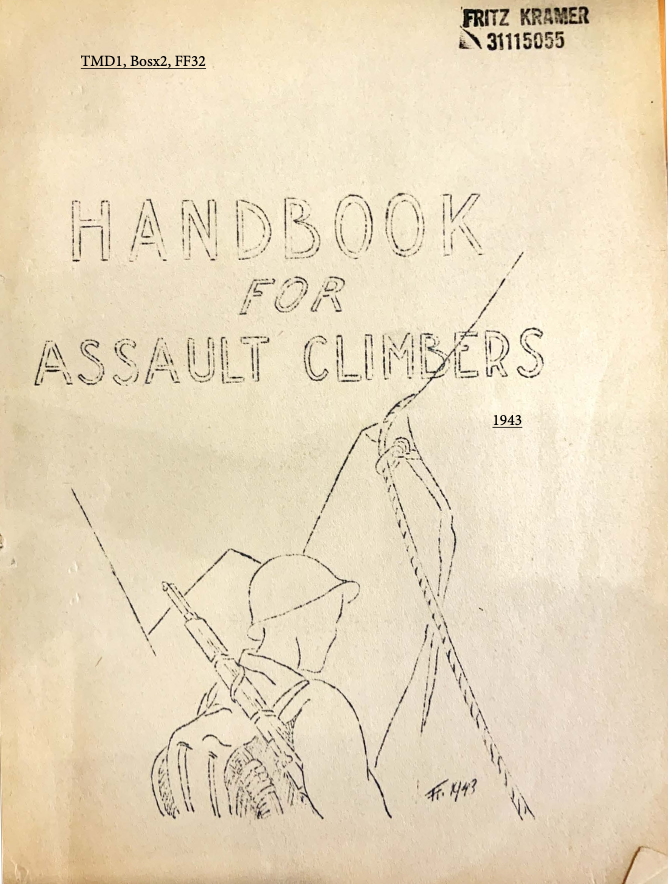
“The trained assault climber,” it continued, “is a mountain guide as well as a fighting man. Many lives may depend upon his choice of climbing routes and his judgment as to the speed with which a mission over cliffs and broken country can be accomplished.”
Assault climbing, in short, allowed small patrols to seize tactical positions in precipitous terrain in advance of the rest of their unit. These patrols were designed to work quietly, independently, autonomously, and, if necessary, at night. They possessed the requisite skill sets to approach a cliff, read its features, select the safest and most efficient line of ascent, and forge their way up using ropes and pitons. Once on top, they could fix lines and prepare routes for the soldiers who followed, hauling weapons, ammunition, and equipment up behind them using rope and pulley systems while the main body of the unit waited below.
And who, you might ask, wrote the Handbook for Assault Climbing? Why, none other than John McCown and his fellow officer 1st Lieutenant Ed Link, together with Hugh Burton, shortly after the Buena Vista Maneuvers were concluded.
OK, back to the plan.
Each RCT would spend five days acclimating to both the terrain and the maneuvers themselves. Once Rolfe and his instructors had toughened them up, the RCTs would go head to head in two-sided maneuvers—real-ish, simulated combat scenarios adjudicated by umpires. The procedure would then be repeated as old RCTs rotated out and new RCTs rotated in.
Perhaps because of their previous training in New Hampshire, the men of the 36th were keen. “In spite of snow and general lack of any facilities in the area,” Gaither wrote, “the unit was setting itself up in a most orderly fashion, indicating excellent handling, high morale, and state of training.”
The GIs of the 45th were another matter. “They appear to be reluctant to participate,” he observed, “due apparently to involvement with amphibious training.”
Sepp Scanlin: “One of the lessons they were still building on was the complexities of conducting beach amphibious landings in contested terrain and that is very difficult. We first experienced it in the North African campaign, but we hadn’t had a ton. More and more of our technology is coming online—things like the duck boats that we all see as tourist boats today—are all fielded to give these advanced amphibious capabilities to begin to do this.
“Before you can get to the mountains, you have to get across the beach. That’s why they combined those two last critical parts because now they’ve committed these units to a location that has that demand. And that’s in McNair’s pipeline: you can take a standard division and then just do some fine-tuning to it for the area that it will be deployed to. Kind of the finishing school before it deploys—and it works.”
The chaos of a landing on enemy-held beachfronts would make them, for a few short hours, the most dangerous places on earth. So AGF, in its infinite wisdom, had decided that not only did the 45th need to train for low-mountain warfare; it had to continue its amphibious training as well, and do it at the same time. “This training is necessary,” it thundered. It had done the math, figured out just how to rotate each of the 45th’s three RCTs from Ft. Pickett 110 miles east to Norfolk, Virginia, subject them to two weeks of amphibious training, truck them back to Pickett, and from there truck them through the Blue Ridge to the Buena Vista Maneuver Area. “[I]t is believed,” read one of the directives, “that mountain training … can be echeloned with amphibious training without serious interference with the latter.”
Rolfe and his men were given six weeks to train the 45th’s combat teams. For the 36th, they were given three. And as Gaither noted, his “staff has had no experience in such matters.”
If it’s difficult to fathom how this could be accomplished without any written manual to go by, try factoring in General Rolfe’s main responsibilities back at Camp Hale. As the test force continued to expand, new recruits were arriving in Colorado by the thousands. They all needed winter training; many of them needed basic training as well. The MTC at Camp Hale was, at that moment, still finalizing a curriculum for the former. Now Rolfe and his retinue, as part of their AGF-mandated side hustle, were being directed to develop a curriculum standard infantry divisions could use to fight in lower-altitude mountains in the summer. If that wasn’t enough, the 87th Mountain Regiment, the OG of his test force and the repository of almost all its institutional knowledge, was about to be sent off on a special mission of its own—to retake the Aleutian island of Kiska from the Japanese. Add all these variables up and you get the impossible equation Rolfe was being asked to resolve.
Sepp Scanlin: “He was given such a difficult mission of literally starting from scratch with everything from—as you as you’ve well documented—there’s no equipment, there’s no manual, he’s building the cadre from literally enlisted men up and simultaneously he’s getting all sorts of not so helpful advice from the chain of command in doing this so he’s swimming upstream in the army bureaucracy. The other thing I’d add is he’s not just doing this—because they’re also tasked to send cold weather trainers.”
So they’re doing mountains on one side, cold weather on another, and they’re still trying to build a division at Camp Hale. Because in the archives, I have orders sending somebody from the Mountain Training Group at Camp Hale to then Pine Camp in upstate New York to train armored divisions in cold weather and winter maneuver and survival. They do the same thing up in Wisconsin and Minnesota, right? Like, they send a bunch of trainers up there. So he’s literally sending his best trainers all over the nation while simultaneously trying to build a division.
Gaither acknowledged as much in his report. General Rolfe’s headquarters, he noted, “is under a heavy load, is harassed with the usual administrative difficulties in setting up a new headquarters, and is in the midst of the acquisition of the [Buena Vista] training area”—all of which led him to observe that they were, as he put it, “a little wobbly on some of their technique and procedure.”
As I mentioned, the Virginia maneuvers have never been examined from the perspective of the mountain troops. Here’s an excerpt from an interview I did with advisory board member Lance Blyth on the topic.
Christian Beckwith: “And it was interesting to hear Nathan Marzoli. He dug up some really good information on these trainings. And one of the comments was that the trainers, so the instructors from the mountain training center were a bit wobbly. And I could see why they would be a bit wobbly.”
Lance Blyth: “Yeah. And I also think that refers to—cuz, remember, while the climbing’s going on, the other couple thousand, they’re marching about getting some acclimation, getting some fitness, and then they’re going through some tactical training. And the guys from Hale had to come out and give that training as well. And they had never had time to develop mountain tactics. Remember they left a week or two after the Homestake Peak fiasco and the whole point of that was to try to figure out how to do some mountain tactics in winter and they didn’t get to it and so they would have been figuring that out on the fly as well.
“The Mountain Training Center: it’s been busy doing lots of other things. It’s, you know, they’re standing up an entire new infantry regiment and having to do its basic training. They have to backfill the 87th Mountain Infantry and they have to do all the survival and ski training for those guys before they can send them to the field. So at the time that this attachment goes back east, the Mountain Training Center is just getting started figuring out how to do this training. Yes, they would have been wobbly. No question.
“You have a Mountain Training Center. It hasn’t been given a lot of time to figure out how to do mountain training ….”
Christian Beckwith: “… And no time in the summer. What you’re experiencing in the spring in Virginia has never been experienced by the army before. It’s ironic that the first application of all that knowledge that had been amassed to this point took place not in the mountains of Colorado, but in the mountains of the Blue Ridge at the Allegheny Mountains of Virginia and West Virginia.”
In other words, it wasn’t just that the file was still thin. Those charged with developing it were overworked, stressed out, and being asked to organize and execute complex objectives with lethal consequences in ridiculously tight time frames. As a result, Gaither concluded by observing that “the maneuver[s] may be extremely free” —Army speak for organized chaos.
It would be inaccurate to say they were starting entirely from scratch. As they taught the Texans of the 36th to climb in New Hampshire, the instructors from Ft. Lewis must have developed some form of curriculum—but if so it has eluded my efforts to find it. Given Gaither’s comments, it seems to have eluded the planners of the Buena Vista Maneuver Area as well.
If there was one document that might have provided a template for their efforts, it was the Proposed Manual for Mountain Troops. As we’ve discussed elsewhere in our story, its eight chapters, which included a distillation of everything the test force had learned to that point about mountain equipment, mountain rations, mountain marches, avalanches, military skiing, first aid in the mountains, transportation of casualties in mountain country, mountain medicine, and mountain weather, had been compiled over the summer and fall of 1942. David Brower–who, as the MTC was setting up shop in Buena Vista, was undergoing OCS at Ft. Benning in preparation for helping to lead the mountain troops himself—had written a chapter on rock climbing as well, but it read far more like a manifesto on military climbing than a how-to for troops. It also remained, like the rest of the manual, unauthorized, leaving General Rolfe and his instructors without a sanctioned fieldbook to guide their instruction.
And they needed one. The program McCown and company were building out on the scruffy crags above the James River was a subset of the larger curriculum General Rolfe required—not just for training standard infantry units, but for preparing his own troops back in Colorado as well.
The official paperwork on the maneuvers—what little of it exists—describes them in perfunctory terms. Here’s Nathan Marzoli.
Nathan Marzoli: “Generally, it was just to familiarize these standard infantry divisions with operations in sort of mountainous and primitive terrain. More specifically—and this is actually straight from the training document: accustom units to mountain conditions, which is sort of characterized by independent action of small infantry units to train in deliberate operations with limited objectives from one terrain phase line—so, one piece of terrain to another; to develop keener sense of terrain within these infantry soldiers; to obtain superior physical conditioning of troops to train these infantry units; to operate potentially without any supporting transport which they were very tied to— the transportation line trucks and so forth; to train the artillery batteries to support infantry actions in this mountainous terrain. Also to train engineers in the rapid construction of roads and improvement of trails because if you’ve ever been out to that area even today a lot of the roads are pretty rough.
“Those were the primary objectives, but it was really to prove, like we were talking about McNair, to prove that these standard infantry divisions could operate in rugged terrain with just minor modifications. Obviously, they couldn’t operate like they were moving across France or something like that in the mountains, but they wanted to prove that they could be flexible because that was important in a world war where you had to have funding and cash considerations where you’re already spending so much money in fighting this war.”
Instruction at both camps was divied up into three blocks of a dozen-ish days each. While the training covered the full gamut of low-mountain warfare, from transportation to feeding the troops to artillery support to communications to engineering and medical matters, the rock climbing is more my cup of tea, so our examination will focus primarily on that.
First up was what I’d call the “here’s the deal” component. Instructors lectured the GIs on how climbing applied to war, introduced them to basic mountaineering terminology and added a bit of rudimentary movement to keep the oxygen flowing. Day two was the “OK, now you try” phase, albeit one conducted in a controlled setting: soldiers learned how to tie knots, handle a rope, catch a fall, and begin to experiment with vertical ascent, though climbs were limited to ten feet off the ground. By the third day, instructors bumped it up a notch, grouping the soldiers into parties of two and three, overseeing climbs up to 30 feet, and then teaching them how to rappel back down.
Day 4 did two things. It not only pulled all the previous elements together—sort your ropes, tie your knots, belay your partner up a route, follow, then rappel back down. It also weeded out the riffraff. Those who couldn’t cut it physically or psychologically—up 40% of each class—were out. Those who could would begin their training in earnest.
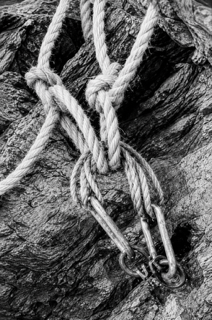
By day 5, they began to learn pitoncraft, the art of protection that allows a climber to nail thin wedges of metal into cracks with a hammer, clip a carabiner (or snaplink, as they called it) through the piton’s eye, and then clip the rope through the biner to protect upward progress. They also began to emphasize route-finding: how to look at a cliff and select the safest, most efficient line of ascent, a mission-critical aspect of the artform that would allow a GI to optimize movement over complicated terrain both for himself and the troops that would follow.
The more I’ve studied the curriculum, the more impressed I’ve become. It not only compressed aspects of the pursuit that take most modern climbers years to master into a dozen days; it did so using an infantryman’s standard equipment. Apart from the ropes and pitons and piton hammers, the only piece of gear the GIs hadn’t already been issued was the packboard, a rudimentary external frame backpack used by American expeditionary climbers before the war to schlepp large loads through the hills on their backs. Everything else was standard issue: standard fatigues, standard helmets, and standard, leather-soled Army boots. Standard, after all, was McNair’s jam: it wasn’t just about standard units learning specialized skills; they would need to apply those skills using their regular-issue equipment as well. In the midst of the greatest expansion in military history, the Army didn’t have the resources to create new stuff for niche aspects of every mission. The hundreds of divisions and millions of troops coming on line would need to make do, as much as possible, with the soldier’s basic kit.
The levels of expertise continued to rise with each new day of instruction. By Day 7, soldiers began to choose their own routes and climb them in small teams as quietly and stealthily as possible with their rifles strapped to their packs. By Day 8, the instructors brought them to new areas so they could familiarize them with different kinds of rock. While the crags above the James River were composed primarily of a broken, chossy-looking quartzite, Sicily’s rock was predominantly limestone, a harder type of stone with more edges but fewer cracks. It wouldn’t be enough for the troops to master a single kind of rock; they’d need to become proficient at applying their skillsets to vertical terrain regardless of its composition.
The last few days of the training threw as many variables at the troops as possible. They were given different kinds of pitons and sent up lines of the instructors’ choosing. They learned not only how to reconnoiter a cliff, but to do so with an eye for climbing it under the cover of darkness, preserving, in all instances, the element of surprise.
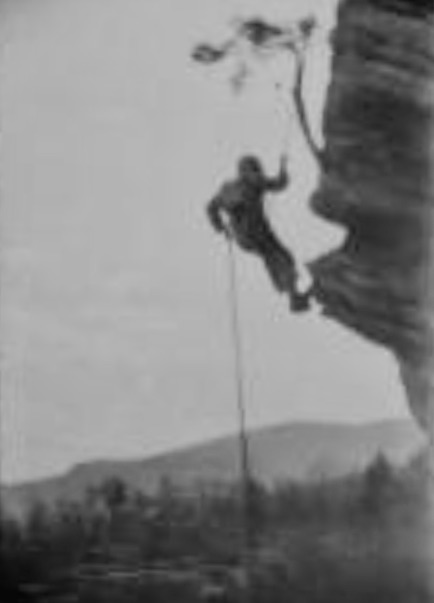
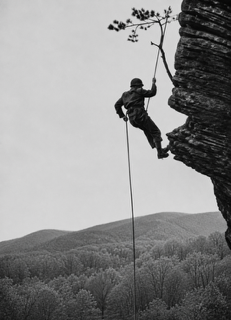
Free climbing is the art of climbing under one’s own power, using the rope and pitons for protection rather than advancement. Much of it occurs on fingers and toes, but all body parts are on. Knees, buttocks, shoulders, elbows, thumbs, chins, or for that matter as much of your body as you can wedge into a chimney: whatever gets you higher, it’s all good. While I personally have never used my tongue for advancement, I guarantee you somebody out there has.
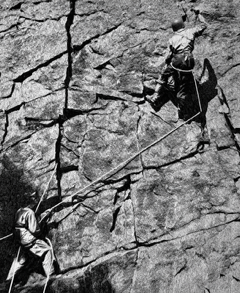
The more the angle of the rock kicks back, or the weirder its composition, or the smaller the holds, or the wilder the conditions, the harder the climbing becomes. At a certain point—and that point varies for everyone, because it depends not only on strength and flexibility and endurance but also psychological components such as the ability to compartmentalize the fear of falling in order to make a move—it’s no longer possible to ascend under one’s own power. When that occurs, climbers rely on what we call aid climbing: pieces of protection—which in 1943 meant pitons—nailed into a crack with a hammer, a carabiner clipped into the eye, the rope clipped into the biner, moving upward, point by point, under tension. It’s slow, tedious work, but it gets the job done when nothing else will—and the MTC instructors imparted this, too, beginning on the night or tenth day, as they taught troops how to fix lines, prussick up them, create suspension traverses, and haul their artillery up the wall.
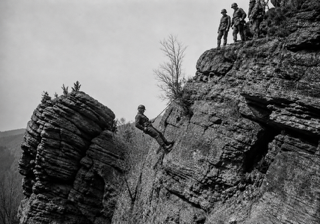
And then, with the closing two days of instruction, came the grand finale: infantrymen who before the war had been officeworkers and farmboys, plumbers and shopclerks, gas station attendants and postal workers, were sent up cliffs at night, where they put all their new-found tactical skills together in the dark.
All of the above is recorded with painfully dry precision in the papers I found in John McCown’s files, which are the same as the ones in the dossier of the maneuvers sent along to me by Nathan Marzoli. Marzoli’s papers included another element as well: 32 photographs, mounted on yellow onionskin paper, with notations and critiques scrawled out below them in pencil, documenting the movement of a critical piece of artillery across a gap with a suspension traverse.
The M1 81 mm mortar was a rugged, portable, 45-pound weapon capable of firing smoke, high-explosive, and illumination rounds more than a mile. Infantry units valued it for its ability to provide rapid, accurate fire support in terrain inaccessible to vehicles that could bring in heavier artillery. Operated by a small crew, the M1 consisted of a smooth metal tube mounted to a 44-pound baseplate and a 46-pound bipod. The shells, which weighed around 15 pounds each, were dropped down the tube and fired automatically once they struck a fixed firing pin at the base. When launched, the rounds could travel in steep arcs onto enemy positions concealed behind ridges, forests, buildings, or defensive fortifications.
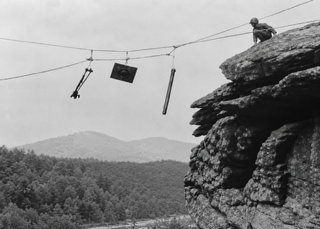
Though the images of the suspension traverse are very small and very grainy, they offer a portrait of the maneuvers in miniature: infantrymen who had never climbed before executing a technically complicated procedure under the supervision of the instructors. They depict troops rappelling down a cliff, establishing an anchor atop a wall on the other side, tensioning a rope across the gap, executing a Tyrolean traverse on the tensioned lines and hauling the mortar across via three different methods, with hand-written notes on the relative quiet of each one. In a few of the photos, the James River winds its way past the proceedings at the base of the cliff, a distant, ancient, rounded mountain visible in the background. It’s the same peak I found in two of Peter Gabriel’s images of the maneuvers shared with me by the New England Ski Museum.
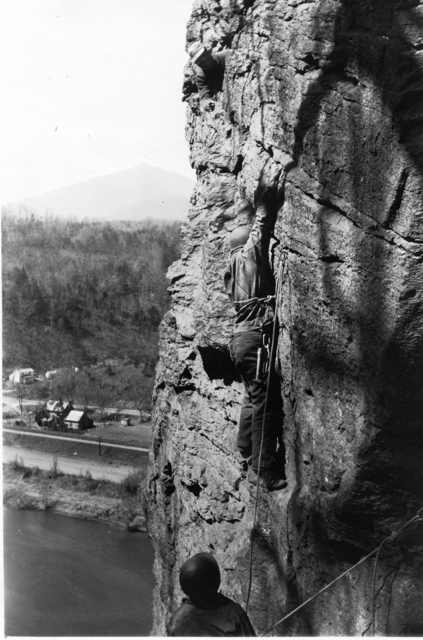
There’s only so much one can glean, though, from official documents, even when they’re photos. In addition to being dry, they also minimize the human dimension—and a story without the human dimension is just facts. Thank God, then, for James Goodwin, who recorded his Virginia experiences in an unpublished memoir. His account—the only first-person record of the maneuvers we have—imbues them with a dash, however small, of humanity.
Goodwin was an Adirondacks guide and American Alpine Club member who’d been saved from a military career stoking furnaces by John McCown. He’d arrived at Camp Hale the previous December, when the smoke from all the coal-burning stoves and coal-powered locomotives hung over the Pando Valley like a shroud. “I was utterly miserable,” he wrote of his early weeks in Colorado. “I was slow in learning close order drill, care of my rifle, how to salute officers and the like… and was therefore given extra clean up assignments and extra K.P….. I took being sworn at and foul-mouthed too seriously. Like millions of others at this stage of history, I realized that I was now a prisoner of the Army with no hope of reprieve until the end of the war that was likely many years away assuming I survived that long.”
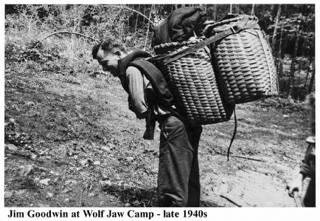
To avoid drill practice, Goodwin had volunteered to shovel coal. When he heard a rumor that rock climbers were being recruited to train troops in Virginia, he hustled to the building without changing his fatigues and joined the line of prospects. He found himself facing “an attractive, alert young second lieutenant.” When John McCown asked for his qualifications and Goodwin responded, hesitantly, that he was a member of the American Alpine Club, McCown exclaimed, “You are? So am I!” and promptly gave him the job.
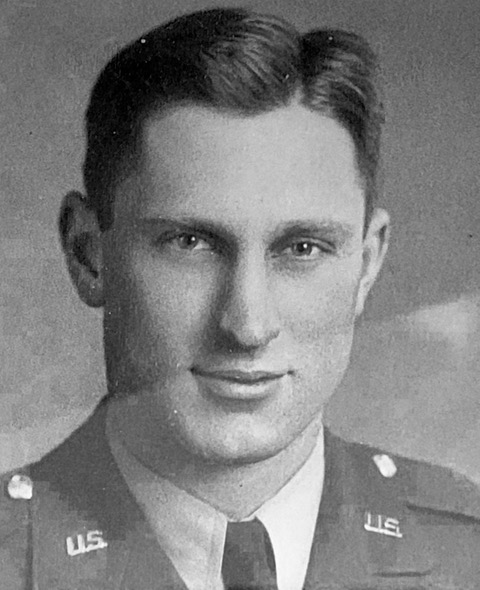
In Virginia, Goodwin was joining some extraordinary company. Two years earlier Tom Campbell had made the first ascent of the South Tower of Howser Spire, a blade of imposing, impeccable granite in Canada’s Bugaboo Spires that rises out of the glacier like the tip of a celestial spear. Campbell had honed his mastery of weather and distance and dubious rock in the North Cascades, often in the company of Jim Nussbaum, a fellow member of the Seattle Mountaineers. Now both of them were privates, instructing alongside Private Goodwin beside the James River.
Joining them at the bottom of the Army’s totem pole, at least in terms of rank, was Joe Leuthold, a Swiss-born, Oregon-raised mountaineering legend. Leuthold had been a guide, ski instructor, and climbing pioneer who’d helped found the Wy’east Climbers, an elite, Depression-era mountaineering confederacy that had fundamentally shaped the Golden Age of climbing on Mount Hood. The only instructor older than the 37-year-old Private Leuthold was 42-year-old Private Elwyn Arps, an American Alpine Club member who’d spent years climbing in his home state of Colorado before joining Uncle Sam’s Army.
If the instructional cadre had a backbone, it was the celebrated ski racer and licensed mountain guide Peter Gabriel. Born into a guiding family in the Swiss Alps, he’d emigrated to America, run New Hampshire’s Franconia ski school and climbed throughout the continent before joining the mountain troops at Fort Lewis. He’d helped perfect their ski techniques and led gear-testing expeditions to the summits of Rainier and Mt. McKinley on their behalf. No one in the test force had been more instrumental to their development than him.
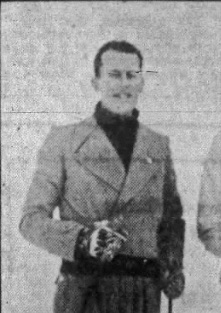
Of all the instructors, though, the California contingent were the undisputed masters of the stone. Argiewicz was a graduate of the Rock Climbing Section of the Sierra Club — one of the only places in prewar America where technical climbing had been pursued with genuine scientific rigor. Rudolph Pundt and Jack Riegelhuth were alumni too, and the three of them understood dynamic belays, tension climbing, and the precise geometry of piton protection better than anyone else in the instructor cadre. Riegelhuth had been part of the Sierra Club’s two expeditions to Mount Waddington; he’d also made the first ascent of Yosemite’s Washington Column, one of the earliest big walls climbed in America. On the day they arrived in Virginia, McCown and Ed Link put the Californians to work conducting a two-day crash course in modern rockcraft for the rest of the instructors. It, in turn, would become the foundation of their curriculum for the troops.
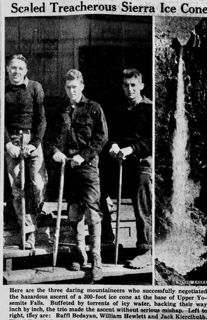
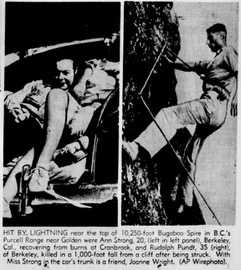
Link was the outlier. A 29-year old 1st Lieutenant from Seattle, he was first and foremost a skier, and though he’d made long ascents to Camp Muir at 10,000 feet on the flanks of Mt. Rainier and participated in the mountain’s infamous Silver Skis race, he knew next to nothing about climbing. What he lacked in technical experience, though, he made up for with his organizational instinct. In a program as poorly defined as theirs, Link was the closest thing they had to a coordinator, and quickly distinguished himself as an excellent executive.
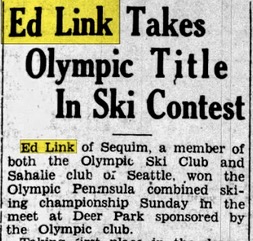
All these men had been selected earlier that winter to teach the soldiers at Camp Hale to ski. They’d barely had time to work on their snow curriculum, though, before they’d received their new assignment in Virginia.
The officers who’d accompanied Rolfe from Colorado included some ringers too. He’d placed Captain Robert Works, a twenty-eight-year-old who had been with the mountain troops since Fort Lewis, in charge of North Camp. He had also appointed Colonel David Ruffner, the principal architect of the mountain troops’ artillery training program, as the Director of Field Artillery. You might remember Ruffner from our last episode: during the Homestake Peak maneuvers, he had directed artillery fire onto the flanks of Homestake Peak so effectively that he brought down an avalanche large enough to nearly take out the dignitaries assembled at the mountain’s base. Whatever one thought of the Homestake Peak fiasco as a whole, no one had questioned the artillery.
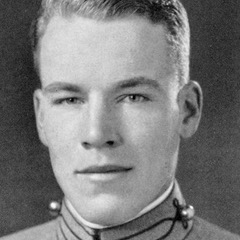
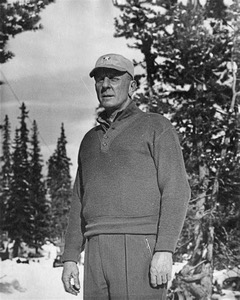
The only way Rolfe could fulfill AGF’s mandate was with men like these: military and mountaineering experts with vast and varied experience across multiple ranges and disciplines, guides who could assuage fear in their students, and alpine veterans who could make difficult terrain look simple as they coached anxious infantrymen up the rock.
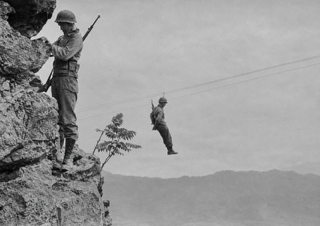
In reading over Goodwin’s memoir, it becomes clear that he was a climber only in the pre-war sense of the word. Most of his ascents in the Adirondacks and Rockies had been of the unprotected variety, steep, non-technical scrambles that rarely required hardware for protection. As he put it, by the time he entered the Army, “I had previously rappelled only three or four times in my life and had only driven three pitons.”
En route to Virginia, Goodwin mounted a self-directed course of inquiry: he read Ken Henderson’s Handbook of American Mountaineering, the book the American Alpine Club had published in 1942 to give the mountain troops something to go by. The crash course worked. Thanks to his studies, “I was able to talk intelligently,” Goodwin wrote, “and put into practice with my students a lot of maneuvers I had never tried before myself.”
Goodwin’s memoir adds dimension to the maneuvers’ official accounts. The “one basic weakness” of the training, he wrote, wasn’t the infantrymen; it was the officers, particularly those of the 36th. Among other things, they’d internalized McNair’s insistence on realistic training a bit too zealously for Goodwin’s liking. A colonel from one of the units they were instructing included this admonishment. “‘Don’t take it to heart if some of your trainees are killed in this … mission. Remember, this is training for war.’”
Goodwin got the point, but agreed with his fellow instructors they’d avoid such an outcome if possible. And they did. “By the Grace of God,” he wrote, “in nearly two years of rock climbing instruction, totaling thousands of troops, the worst calamity to any of our trainees was one broken leg.”
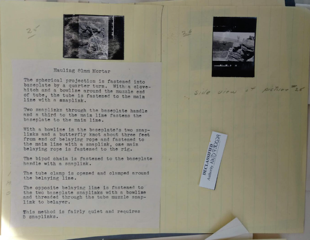
What Goodwin really found disturbing, though, was the officers’ attitudes.
“None of the officers joined our climbing classes,” he wrote. “They just walked around at the cliff bottoms watching their men climb.” The following year, when the Texans found themselves enmeshed in a battle to take the ancient hilltop monastery of Monte Cassino in central Italy, the pattern was repeated. “In Allied attempts to take that cliff-bound monastery used by the Germans to direct artillery fire,“ he recalled, “[o]ur former enlisted trainees were unfortunately sent on suicide missions that didn’t make sense…. Most of ‘our’ men were killed.”
By early April, Goodwin, McCown and company had distilled their instruction to a science, and Rolfe had spent nearly five weeks coordinating the maneuvers overall. On April 4, he sat down and banged out a summary of what he’d observed for his boss.
Rolfe’s political acumen was too acute, at this point in his career, to tell McNair that training a standard infantry division to fight in the mountains wasn’t possible—in part because it was. “The present organization of the standard division,” he wrote, in the very first line, “is suitable for operations in mountainous terrain.” The devil, though, was in the details—and they took up the bulk of Rolfe’s report.
First, mountain fighting required a far higher level of fitness than that produced by standard units. Moving on flat ground with a pack is hard enough. Moving on steep terrain with an even heavier pack, up and down thousands of feet of elevation, across broken, roadless ground with limited visibility and underbrush grabbing at your ankles is a different proposition entirely. Soldiers needed time to adjust to that reality before they could fight in it.
Second, mountains forced commanders to let go of control in ways that flatland warfare did not. In the Blue Ridge, a battalion that set out as a single unit would string itself out over four miles of trail within an hour, with the head and tail of the column separated by thousands of feet of elevation and potentially hours of marching time. You couldn’t manage it from the front; you also couldn’t manage it from the rear. The only solution was to break it into smaller, self-sufficient teams — companies, platoons, squads — each capable of making its own decisions and fighting its own fight until it could link up with the rest. That kind of decentralized command ran counter to the instincts of officers trained for set-piece operations on open ground.
Third, and most practically: The vehicle fleet that formed the backbone of a standard division’s logistics were, in the mountains, nearly useless. Once you left the tarmac, only the six-wheel-drive truck known as the Deuce and a half and the ¼ ton jeep would do you any good. The former, a two-and-a-half-ton vehicle capable of carrying up to five-ton loads, could get you as far as a staging area. From there, the jeep could get you to the end of most roads—but anything that needed to be carried forward after that would have to be done so by the soldiers themselves, on their backs.
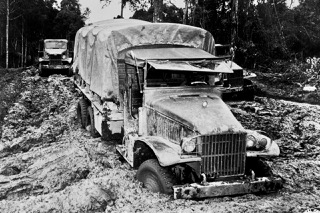
Rolfe was quick to point out solutions to all these issues. But by the time he’d reached his conclusion, he’d laid out the basic reality of fighting in the mountains: it required soldiers to carry more, depend on less, and make more decisions on their own than any standard training program had prepared them for.
Could a standard triangular division operate in mountainous terrain? Yes — but only where the road network permitted the use of the six-wheel drive Deuce and a half, and only with the modifications he’d laid out.
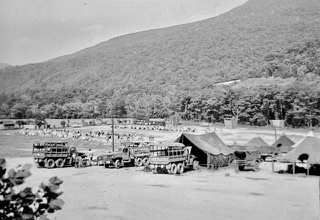
Absent such conditions, “it is necessary,” he wrote, “that a special type light division be formed and trained.” Such a division, he continued, should have jeeps, pack animals to carry the loads when the road ran out, and packboards so the soldiers could carry what the pack animals wouldn’t. It would also, he concluded, require what McNair was reluctant to provide: a specialized division of mountain troops.
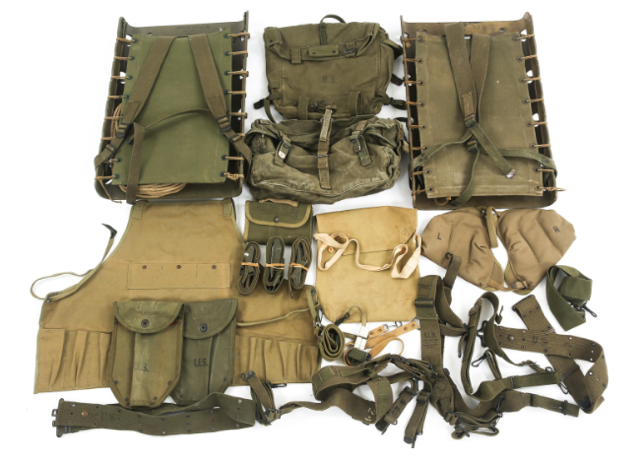
Three months later, at Camp Hale, the test force Rolfe had been working to develop since Ft. Lewis would be converted into the 10th Light Division (Alpine). It had jeeps and mules and soldiers who were fit enough to carry everything else they needed on packboards. They had trained to operate autonomously and could execute their missions without superior orders when necessary. The only thing they wouldn’t have was Rolfe as their commanding officer.
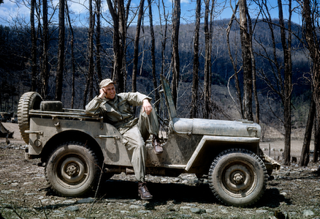
There was more in Rolfe’s report, of course, including the outline of a thirty-day program AGF could use to prepare a standard division to fight in the mountains in the future. Attached to the report was an addendum, “Notes on Mountain Warfare,” written by the West Point grad from Minnesota, Captain Works. The addendum detailed everything that had functioned well and everything that hadn’t during the maneuvers. Complete with hand-drawn sketches depicting platoon march formations and company bivouac layouts, it emerged as the first practical guide to operating an infantry division in mountainous terrain the Army had ever produced.
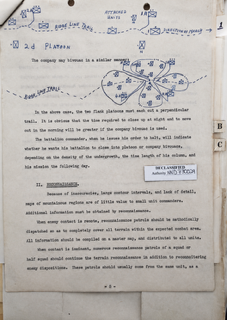
But of all the points Rolfe and Works made in the report, the central one was this: the standard American infantry division had been designed for roads. In their absence—which, in the mountains, happened more often than not—you needed to be prepared to operate without them.
Ironically, Rolfe wouldn’t have been able to reach his conclusions without the specialized training he and his test force had gone through at Camp Hale and on the flanks of Mt. Rainier. His mindset had flipped from roadbound to roadless thinking long before the Buena Vista maneuvers. They’d simply underscored what he already knew to be true.
Whether the irony was lost on McNair is unclear. All we know is that, six days after Rolfe typed up his report, McNair was standing at the base of a cliff above the James River, watching soldiers from Oklahoma and New Mexico and Arizona do things that no standard division had ever done before, a few short weeks before he sent them off to war.
The Virginia maneuvers ended on April 15, 1943. Sometime between their close and the start of the rock climbing training in Camp Hale, a few things happened.
For one, McCown caught a lift to Philadelphia to see his family with Goodwin, whose wife Jane, in flagrant disregard of all the secrecy shrouding the maneuvers, had traveled from Camp Hale to Virginia to find her husband.
“I returned from work one afternoon,” Goodwin wrote, “to be told by Art Argiewics that my wife had just arrived in our camping area! . …” Jane had driven the family station wagon past the military police and the army trucks directly into the middle of the Arnold Valley and its field of walled tents. “If I had been in the German Army I probably would have been shot, but bless McCown and Link. They welcomed Jane, said it was great that she had come, and told me to [go] live with [her] ….. At least in the 10th Mountain Division, military life wasn’t all by the book.”
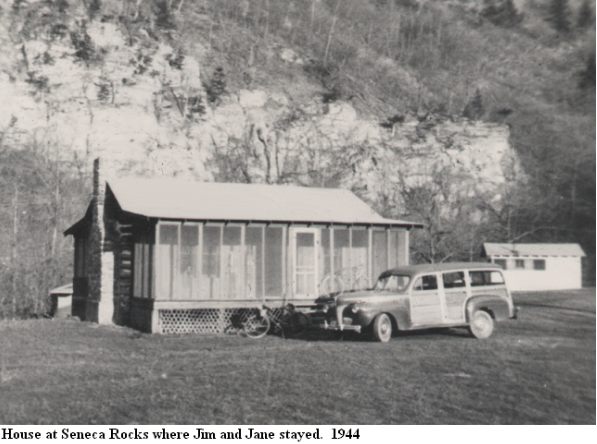
For another, John McCown sat down with Ed Link and recorded the training schedule in a 14-page document that fit into a manila folder. I know, because I found it in one, in McCown’s files in the Denver Public Library.
Entitled The Arnold Valley Detachment MTC Climbing Schedule, the document was a retroactive record of their instruction. March 11, 1943, for example, is noted, parenthetically, as “(Rainy Day)”. The next morning, from 8:30-9:00, notes “late breakfast.”
Which is why I wrote the opening scene. There, in the notes for April 10, 1943, sits this line: “1300-1830: Preparation for, and giving school demonstration for General McNair and party–belaying, suspension traverse, rappelling, party climbing without pitons and with pitons. Fixed rope traverse, and tactical climb.”
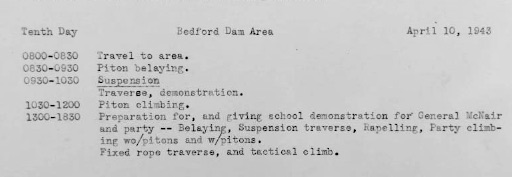
The document, which is signed, on the final page, by 1st Lieutenant Link, offers more than an eyebrow-knitting exercise in reading between the lines to figure out what might have transpired on the outcroppings above the James River. It stands as the first documented curriculum ever produced by the US Army to train its infantry to assault cliffs and enemy positions, secure them, and prepare the way for subsequent waves of soldiers to continue the attack. The Achilles heel of the mountain troops, the one Colonel Gaither had been struggling with since before the war, had finally been addressed.
I found something else in John McCown’s files too. Entitled, “Outline: Ten-Day Assault Climbing Course,” it distilled everything the instructors had taught the troops in Buena Vista to a single page.
Fast forward to the middle of February, 1945, in Italy’s Apennine mountains, when, under cover of darkness, John McCown led a series of silent, lightless recon missions up the steepest part of Riva Ridge with his eight-man patrol. The result was Route 3, a line that included six sandstone steps, all of which John fixed to facilitate the advance of the 86th Mountain Regiment’s C Company, which he then led back up the line in the middle of the night on February 18. The result was the signature offensive of the 10th Mountain Division, one that broke Hitler’s Gothic Line and helped end the war in Italy—and the skills John needed to unlock the mountain’s riddle were all contained in that ten-day outline.
The next paper in McCown’s files was another one-page overview, this one with a specific subject line.
Seneca School, read the title. Assault Climbing Schedule, April 17-30. More advanced than the Ten-Day Outline, it offered yet another distillation of everything that had come before it, in a 13-day course the army had already begun to plan in West Virginia’s Alleghany mountains.
Iteration after iteration after iteration, each one sharper and more focused than the last, all made possible by the thousands of hours John McCown and the MTC had poured into the training it had undergone over the preceding 18 furious, chaotic months.
That’s why John was frustrated with McNair. Yes, a standard triangular division could operate in rugged terrain, given the right training. Its soldiers needed to be in peak physical condition. It needed some kind of road network. And it needed — AGF would eventually concede in doctrine — specialized technical training for terrain that exceeded those conditions.
But without the mountain troops, that soon-to-be division composed of men like John McCown, the process of iteration and distillation could never have occurred.
We’ll never know exactly what McNair thought of the maneuvers, but we do know what happened next. Five days after he stood at the base of that cliff, as the soldiers he’d watched climbing embarked on ships bound for war, he traveled to Tunisia to observe American forces eject Rommel from North Africa. No one had worked harder to ensure his troops were ready for battle, and he wanted a front-row seat to the proceedings. To get it, he traveled to the front — where shrapnel from a German artillery shell embedded in his skull. Despite his wounds, he left the hospital after two days, traveled home to the States and was back at work at AGF headquarters in a little more than a week.
Fourteen months later, McNair returned to Europe to observe Operation Cobra, the American breakout from the Normandy beachhead. In his biography, General Lesley J. McNair: Unsung Architect of the U. S. Army, historian Mark Calhoun noted that, with mobilization of new divisions complete, McNair’s job at AGF was essentially done, and he’d been given a new assignment, part of a deception to convince the Germans that Normandy was a feint. He was at the front once more when American heavy bombers, attempting to carpet-bomb German positions ahead of the advance, dropped their loads short and hit American lines. McNair was killed in the bombing—the highest-ranking American officer to die in Europe during the war. Of the incident, Calhoun wrote, “McNair’s death, which the Army initially reported as the result of German fire but later admitted was the result of a poorly aimed American aerial barrage, prevented him from witnessing the eventual victory of the ground forces he worked so diligently to prepare for combat.”
Germany, meanwhile, needed a massive attack to reverse its fortunes on the Eastern Front after the catastrophe of Stalingrad. On July 5th, Hitler launched Operation Citadel, a million-man, 2,700-tank effort to cut off and destroy the Soviet forces that had pushed deep into German-held territory around the city of Kursk.
Five days later the 45th Division landed near the fishing village of Scoglitti. In the hills above those beaches, in the stone villages and terraced vineyards and cliff-bound Axis positions of the Sicilian campaign, the soldiers quickly came to appreciate their Virginia training. They fought their way across the island in a fast-moving, brutal campaign, employing every trick they’d learned from the mountain troops along the way.
Operation Husky ended in mid-August with Sicily in Allied hands. The invasion not only toppled Mussolini’s regime and knocked Italy out of the war. It compelled Hitler to redirect forces from the Eastern Front to Sicily. As a result, he called off Operation Citadel after just eight days, handing the Soviets a decisive strategic victory from which the Axis would never recover.
The Texans of the 36th never made it to Sicily—at the last minute, General Patton redirected them to mainland Italy instead—but their training in Virginia paid dividends nonetheless. On September 3—the same day Italy secretly signed an armistice—British and Canadian forces crossed the Strait of Messina and landed on the toe of the Italian boot. Six days later, the Texans entered combat at Salerno as part of Operation Avalanche, the Allied invasion of Italy. They were the first American division to land on mainland Europe, and they landed into a maelstrom. German panzers counterattacked with devastating force, driving so close to the beach that the Allied commander briefly considered evacuation. The beachhead held, barely. Italy was not going to be the soft underbelly Churchill had predicted after all.
The mountains that ran the length of the peninsula like a spine would make every mile a siege, and the Germans — retreating deliberately, fighting from prepared positions on high ground — would exact a brutal price for every one of them.
Over twenty months of near-continuous fighting, the Texans battled through Salerno, San Pietro, and Anzio, the lessons of Buena Vista informing their every encounter. Redeployed to Southern France in August 1944, they pushed north through the Vosges Mountains, where one of their units—known, forever after, as the “Lost Battalion” of the 141st Infantry—was cut off and surrounded. In one of the war’s most costly actions, 211 survivors were rescued, after days of brutal fighting and more than 800 casualties, by the segregated Japanese-American 442nd Regimental Combat Team.
The 36th continued fighting all the way into Germany. They endured staggering losses, breached the Siegfried Line, and ended the war in Austria after more than 400 days in combat.
The lessons of the Blue Ridge had, for the 36th and the 45th, translated almost immediately into combat in Europe. In his article, Marzoli argued that the Virginia program, for all its haste and brevity, “paid tremendous dividends for the Army,” more than justifying itself once the troops reached the battlefield.
The commander of the 45th, Major General Troy Middleton, agreed. After battling through Sicily and onto the Italian mainland, he reported that the training his men had received in Virginia’s primitive area had proven its worth. It had been, he wrote, “the best substitute” for actual mountain combat.
There were other ripple effects as well.
The addendum to Rolfe’s April 4 report written by Colonel Robert Works had created a prototypical field manual that commanding officers could use to get the job done in low-altitude mountains. That codification became official after the Virginia maneuvers concluded.
Lance Blyth: “This is the first place you point out the Mountain Training Center really had to write it down and use it—what they knew. So you start getting a series of things written down. What the people who did this turned out with, they put together a handbook so they have something they can rely on that they can show. Here: it says this. And they can then give that to units.”
Here’s Nathan Marzoli.
Nathan Marzoli: “They took those lessons learned and applied them into this field manual. And that was important because at least you had something to be able to hand units once they were overseas and maybe in this type of terrain to say, “Hey, this is how you should employ your forces.” Then you didn’t have to have soldiers go through divisional maneuvers. Not as good as hands-on training, as it never is, but at least you had something.”
The maneuvers also paid immediate dividends back in Colorado.
Christian Beckwith: “What kind of cross-pollination do you imagine was going on when they got back to Camp Hale?”
Lance Blyth: “Yeah, it was completely massive because we know that the first mountain school schedule at Hale is the 87th Infantry’s Mountain School and it’s a two-week school and that must have been written with those guys’ help as soon as they get back.”
Christian Beckwith: “When did that begin?”
Lance Blyth: “It would have been in April and May of 43. So it would have been just as these guys were getting back. Yeah, just they came back and was that the catalyst? Did they come back with a bunch of energy and go, ‘Hey, we know how to do this now. Okay, let’s grab a bunch of guys out of the 87th and let’s run them through this training as well.'”
Both Robert Works and his fellow MTC officer Colonel David Ruffner, who’d written up the final report on the maneuvers on April 15th, would go on to play key roles in the 10th’s success in Italy. Works helped plan the taking of Mt. Belvedere in the Italian Apennines that broke Hitler’s Gothic Line. Promoted to brigadier general in 1943, Ruffner commanded the Division’s artillery through its Italian deployment, playing a key role in the campaigns from Mount Belvedere to the Po River. The skills both men needed for those roles —operational planning, intelligence analysis, and an ability to synthesize information from multiple sources—had begun to come into focus in Virginia. The officers of the MTC had benefited from the low-mountain training at least as much as the American GIs they oversaw.
Here’s Sepp Scanlin again.
Sepp Scanlin: “They’re constantly being tested. They’re also getting to know how to manage men in military contexts. You know, you do a good job of walking through this pipeline. We’re still two years in. Your protagonist has gone from being an enlisted guy to going to officer training school to now running a training program where he is seeing troops upon troops upon troops in a very short order—where he has to give pretty complex instruction. That’s all building blocks that are simultaneously training the unit to be successful but also training him to be successful and a future leader of men. He had those organic skill sets, it’s quite clear from what you’ve laid out, but the fine-tuning of those skills in a military context is happening in all of these exercises.”
Christian Beckwith: “In real time.”
Sepp Scanlin: “In real time.”
So who was right about specialization? Could it be applied, as McNair insisted, at the tail end of a standard unit’s training—a finishing school just before it was sent off to war? Or did Colonel Ridgely Gaither, General Rolfe and John McCown have it right all along? Did deeper engagement in mountainous terrain—without roadnets, in winter and at higher altitudes—require a specialized division of troops, who could, among other things, serve as the instructor cadre McNair needed to make his vision a reality?
Lance Blyth: “The assault climber handbook that Link and McCown put together: this is kind of the first codification of US military mountain climbing. It’s not just at Hale. It’s given to all these units as they come through.”
“In that is a chapter on assault climbing and in that one—Robert Works was a senior guy. He basically says—paragraph three in this handbook, in the first chapter, states that: ‘standard infantry, properly trained and conditioned, can successfully operate in terrain similar to the Appalachian Mountains where the road net is adequate’—a caveat there. ‘For more difficult or alpine terrain, specially trained and equipped mountain troops are necessary.’
“So what they learned from this experiment throughout 1943 was yes, you can do it in the low mountains, if you have the roads, but once you go above tree line and get into the alpine or get any sort of rougher terrain, you’re still going to need specialized units.
“The problem with the maneuver areas is they didn’t train entire divisions. They trained parts of divisions, regimental combat teams at a time. Division staff were not there and they only did it for a couple of weeks. If you’re going to train units in the mountains, you got to send the whole unit there for months. You got to be in both seasons and that takes time and that takes committing an entire division. And McNair was never willing to do that. He would have a change of heart, but it’d be around the whole light division experiment that comes up in July of 1943.
“McNair’s idea of, like, we can take a standard division, we can give it the specialized training, give it the specialized equipment and it can operate in any environment including the mountains. So McNair was half right.”
As for those GIs that did get the training: did they have an impact on outdoor rec in America after the war? While there’s no way of knowing for sure, we can make an educated guess.
All too often, when we speak about the 10th, we speak in terms of the men assigned to its various camps and deployments. According to our advisory board member David Little, 32,234 men were assigned to the mountain troops at some point between the 1941 activation of the test force at Ft. Lewis and the Division’s deactivation in 1945.
As I’ve laid out elsewhere in this series, there were some 12,000 members of the country’s various mountaineering clubs before the war. Of those, I’ve calculated that somewhere between 500 and 1,000 had technical skills like the ones being taught above the James River.
Approximately 13,000 soldiers received low-mountain training in the Buena Vista Maneuver Area. An additional 200 men, conservatively speaking, learned the advanced skill sets of the Sierra Club climbers. Add them up, and you can see why I believe the Buena Vista maneuvers were important: they familiarized thousands of American GIs with the art of self-sufficient in the backcountry, and,together with the 200 officers and noncoms of the 36th that John Reid and company had taught to climb in New Hampshire, they nearly doubled the amount of technical rock climbing expertise in this country.
Lance Blyth: “My—again, supposition—is that so you have this ton of guys who had climbed. They influence a few more. David Brower would take that climbing chapter he wrote for the manual and when he updates the Manual of Ski Mountaineering after the war he adds that climbing chapter to the Manual of Ski Mountaineering and there were people who use that to learn to climb, bringing that Sierra Club rock climbing—that’s really American climbing—belaying a lead climber who can be bold. There is this explosion from what I have read and I think you have too 1950s, 60s, use of climbers going everywhere. The maneuver areas, they are another piece of evidence for the argument I’ve heard you make, and I think is accurate, of the democratization of the outdoors. People who never would have been climbers are suddenly exposed to climbing. They start going out and do more climbing at many different places. If you’re going to go climbing, you’ve got to know some basics. You’ve got to have some basic gear and you’ve got to know where to go. And those things come out of the maneuver experience.”
How many of the GIs who trained in Virginia actually walked into Army surplus stores after the war, bought the equipment they’d learned on and used it to teach their families the same skills is impossible to determine. Still, it’s safe to assume some of them did—and their numbers would mushroom further with the next phase of low-mountain training.
Though the performance of the 45th and the 36th in Europe was all the justification AGF needed to continue the program, the Buena Vista maneuver area itself had proven problematic. The Army had butted heads with the National Park Service, the National Forest Service, and the nearby city of Lynchburg — which had designated a significant portion of the terrain between Buena Vista and Lowesville as a protected watershed, marked in blue ink on the operational maps and off-limits to training.
By mid-April, AGF had made a decision: it would continue training standard infantry divisions in low-mountain warfare, but this time, it would do so further to the north, in the Allegheny Mountains of West Virginia—where a formation of sandstone fins rising nine hundred feet above another river would give McCown and his instructors something they hadn’t had in Virginia: rock that was actually worth climbing.
But that — and what happened when McCown and his instructors returned to Colorado as the rock climbing training was about to open at Camp Hale — is a story for another day.
—–
And that concludes today’s episode—thank you for listening. If you liked what you heard today, tell your friends about our story, leave us a review on apple or spotify, or go on over to christianbeckwith.com to join our community of patrons who help underwrite the project. I’d like to thank our newest patrons, Scott Bassman, Laura Tewnion, Eli Feret, Paul McKean, Ian Pihl, Ben Hoffman, Don Elting, Cristina Quintero and Steve McCarthy for helping underwrite this episode. Without their support, our thorough examination of the 10th’s many rabbit holes simply wouldn’t be possible.
A big round of thanks goes out to our sponsors, CiloGear, Snake River Brewing, DPS skis and Outdoor Research; our partners, The 10th Mountain Division Foundation, the Denver Public Library, the 10th Mountain Division Descendants and the 10th Mountain Alpine Club and as always our advisory board, Lance Blythe, McKay Jenkins, Chris Juergens, Jeff Leich, David Little, Sepp Scanlin, Keli Schmid and Doug Schmidt.
I’d also like to thank General Scott Naumann, the Commanding General of the 10th Mountain Division, for inviting me out to Ft. Drum this spring. It is always an honor to share our story on the division’s base, and always inspiring to see how the modern 10th is carrying on its remarkable legacy.
Until next time, thanks again for joining us. I hope you get outside and do something wild today. Remember, climbing and ski mountaineering are dangerous—but without risk, there is no adventure. Have fun, stay safe, and stay in touch.